Customs law is an interesting practice because we get to see all of the interesting things that come into the country. Granted, a lot of it is pieces of machinery, chemicals, and goods for resale. Now and again, something strange or unexpected shows up. Couple that with my belief that the Harmonized Tariff Schedule of the United States provides the legal means of determining important philosophical questions such as whether something is art or is holy. These questions are, sort of, the issue in HQ H136955 (Aug. 6, 2014), which for some reason was only recently published.
The merchandise at issue is the 3/4 round depiction of Our Lady of Guadalupe with surrounding rays of light. The issue is whether this is a statuette or ornament of wood of HTSUS heading 4420, an original sculpture of Heading 9703, or an article for use by a religious institution of HTSUS item 9810.00.25.

The starting place for this analysis is that Note 1(r) to Chapter 44 excludes works of art of Chapter 97. That means the first philosophical question to be addressed is whether the above depiction of Mary is a work of "art" as opposed to a commercial craft. While artists, collectors, curators, and academics might argue that the definition of art is profoundly subjective, Customs does not work that way.
To be classifiable in Heading 9703, the item must be an "original" sculpture, ancient or modern. That excludes decorative items of conventional craftsmanship of a commercial nature. That means the random coconut carved into the head of a monkey is not likely to be "art" by this definition because the workmanship is conventional and commercial. Court cases have held that a statue is original if the artist exercised his or her own aesthetic imagination and artistic conception when creating the work.
It turns out that this image is basically a three-dimensional copy of images dating back to 1531. Stick with me here as I am way out of my comfort zone. In 1531 Mary appeared to Juan Diego. After the event, his cloak was miraculously imprinted with a version of the image depicted in the statue and also "countless" similar depictions. See, for example, this image of Juan Diego from Catholic.org:

And here is the "original:"
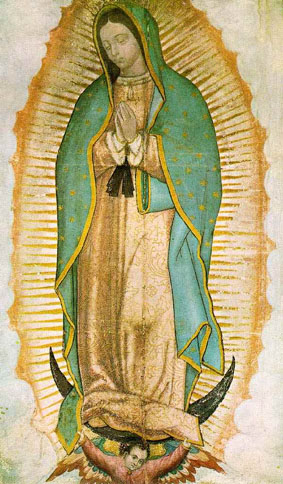
You can see that the imported statue does not show a lot of aesthetic imagination or artistic conception. Consequently, CBP declared it to not be "art." Also, there was no evidence presented establishing the identity of an artist who might have exercised some artistic imagination. That prevents classification in 9703.
What about 9810.00.25? This is an interesting question. The tariff item covers:
According to CBP, articles classifiable in this tariff item must be subject to a pre-importation sale to a religious institution. Here, it appears the item may have been sold to a church, but there is a failure of adequate proof. There is an inconsistency between the commercial invoice, which describes a 3/4 round statue, and the purchase order, which describes a fully round statue. Other documents do not list the church as party to the transaction. In addition, the entity listed as the importer is a re-seller of this type of merchandise and maintains an inventory of similar statues. IMports for re-sale would not fall within this tariff item.
As a result, Customs was not convinced that this particular statue was destined for use by a religious institution. Customs, therefore, rejected the possible classification in Heading 9810.
The statue of Our Lady of Guadalupe was, therefore, classified in tariff item 4420.10.00 with a 3.2% rate of duty.
The merchandise at issue is the 3/4 round depiction of Our Lady of Guadalupe with surrounding rays of light. The issue is whether this is a statuette or ornament of wood of HTSUS heading 4420, an original sculpture of Heading 9703, or an article for use by a religious institution of HTSUS item 9810.00.25.

The starting place for this analysis is that Note 1(r) to Chapter 44 excludes works of art of Chapter 97. That means the first philosophical question to be addressed is whether the above depiction of Mary is a work of "art" as opposed to a commercial craft. While artists, collectors, curators, and academics might argue that the definition of art is profoundly subjective, Customs does not work that way.
To be classifiable in Heading 9703, the item must be an "original" sculpture, ancient or modern. That excludes decorative items of conventional craftsmanship of a commercial nature. That means the random coconut carved into the head of a monkey is not likely to be "art" by this definition because the workmanship is conventional and commercial. Court cases have held that a statue is original if the artist exercised his or her own aesthetic imagination and artistic conception when creating the work.
It turns out that this image is basically a three-dimensional copy of images dating back to 1531. Stick with me here as I am way out of my comfort zone. In 1531 Mary appeared to Juan Diego. After the event, his cloak was miraculously imprinted with a version of the image depicted in the statue and also "countless" similar depictions. See, for example, this image of Juan Diego from Catholic.org:
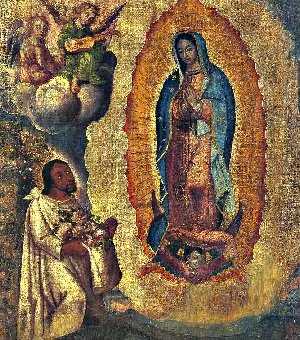
And here is the "original:"
You can see that the imported statue does not show a lot of aesthetic imagination or artistic conception. Consequently, CBP declared it to not be "art." Also, there was no evidence presented establishing the identity of an artist who might have exercised some artistic imagination. That prevents classification in 9703.
What about 9810.00.25? This is an interesting question. The tariff item covers:
Articles imported for the use of an institution established solely for religious purposes:
Articles imported for the use of an institution organized and operated for religious purposes, including cemeteries, schools, hospitals, orphanages and similar nonprofit activities staffed and controlled by such institution:
Altars, pulpits, communion tables, baptismal fonts, shrines, mosaics, iconostases, or parts, appurtenances or adjuncts of any of the foregoing, whether to be physically joined thereto or not, and statuary (except granite or marble cemetery headstones, granite or marble grave markers and granite or marble feature memorials, and except casts of plaster of Paris, or of compositions of paper or papier-mâché)
According to CBP, articles classifiable in this tariff item must be subject to a pre-importation sale to a religious institution. Here, it appears the item may have been sold to a church, but there is a failure of adequate proof. There is an inconsistency between the commercial invoice, which describes a 3/4 round statue, and the purchase order, which describes a fully round statue. Other documents do not list the church as party to the transaction. In addition, the entity listed as the importer is a re-seller of this type of merchandise and maintains an inventory of similar statues. IMports for re-sale would not fall within this tariff item.
As a result, Customs was not convinced that this particular statue was destined for use by a religious institution. Customs, therefore, rejected the possible classification in Heading 9810.
The statue of Our Lady of Guadalupe was, therefore, classified in tariff item 4420.10.00 with a 3.2% rate of duty.


