Essential Identity & Mobile Homes


When I saw that the Court of International Trade issued an opinion in a case called Pleasure-Way Industries, Inc. v. United States, I was hoping for something more salacious than the tariff treatment of mobile homes from Canada. Despite my prurient disappointment, this is an interesting case and raises a couple interesting questions.

As with many classification cases, the material facts are not in dispute. The plaintiff purchased Sprinter vans in the United States and exported them to Canada. In Canada, the plaintiff converted the vehicles into motor homes (or possibly the "tiny house" to which I aspire). That conversion included new flooring, cabinets, plumbing (including a toilet and shower), kitchenette, and a propane system. When returned to the US, the plaintiff believes the vehicles should be afforded a duty preference under HTSUS item 9802.00.50 as “[a]rticles returned to the United States after having been exported to be advanced in value or improved in condition by any process of manufacture or other means . . . .”

Pleasure-Way took the smart initial step of seeking a binding ruling from Customs on this question. It received a positive response indicating that the imported mobile homes qualified as duty-free under 9802.00.50. Customs, however, subsequently revoked that ruling on the grounds that Pleasure-Way had failed to disclose that similar or identical transactions had taken place or were pending. That is an important lesson. While this rule, 19 CFR 177.1(a)(2)(ii), is often ignored or finessed by both sides, it does technically preclude a ruling in this circumstance. Thus, the bind ruling was revoked and declared void. But, read it. The analysis is perfectly reasonable.

Customs then liquidated the vehicles without the benefit of 9802 and, therefore, assessed duty. Plaintiff protested. Surprisingly, Customs did not adopt the analysis it previously employed in the revoked ruling and denied the protest. That brings us to the Court of International Trade.

The issue here is not whether the vehicle was advanced in value or improved in condition in Canada. It was.  The question is whether the article returned to the US is the same article that was exported. This may seem silly, but it matters because 9802.00.50 only applies to items returned to the US. That means that the processing in Canada cannot produce a new and different article. It if does, the item is new and is not “returning.”

This feels a lot like other customs questions, but it is unique. This is not an issue of substantial transformation and whether the mobile home is an article of Canada. That is a similar question, but it is not what defines 9802.00.50. This is also not a question of “essential character,” with which it is sometimes confused. The question here is whether the exported Sprinter retains its “essential identity” after being converted to a mobile home. Put in that light, this is a more complex question.

The customs regulations address this issue at 19 CFR 181.64. According to the regulation, the duty preference does not apply “to goods which, in their condition as exported from the United States to Canada or Mexico, are incomplete for their intended use and for which the processing operation performed in Canada or Mexico constitutes an operation that is performed as a matter of course in the preparation or manufacture of finished goods.” What this regulation does is tell us that advancing in value and improving the condition does not include the manufacturing of the finished article. In other words, the exported item needs to be the finished article and the processing in Canada or Mexico can only improve on that finished article.

Applying that analysis here, the Court found that the “finished goods” refers to the imported mobile homes, not the exported Sprinters. Further, the Sprinters are exported as part of the supply chain for making the mobile homes, which means the exportation is performed as a matter of course in the manufacture of the mobile homes. Thus, 9802.00.50 is inapplicable and the Court rendered judgment for Customs.

There is a little more to this, and that is where the problems arise.

First, the HTSUS, which is a statute, does not include the limitation found in the regulation. The HTSUS says, in its entirety,

 
9802.00.50 Articles returned to the United States after having been exported to be advanced in value or improved in condition by any process of manufacture or other means: Articles exported for repairs or alternation: Other.


Ignoring the regulation, can Plaintiff win this case? If so, then the question is whether the regulation is consistent with a “permissible” (meaning “reasonable”) reading of the HTSUS. If Congress made it clear that this HTSUS provision should apply in this circumstance, no regulation from Customs can change that. In that case, the regulation would be invalid as ultra vires. But, I don' think that happened here. The tariff item clearly requires that the article be returned. Implied in that is that it is the same article coming back to the US. The mobile home was, according to the Court of International Trade, not the same article as the Sprinter that was sent to Canada.
On balance, this strikes me as a good result. One thing I really don't like is that rather than focus on "essential identity," as has been done in prior cases, the Court inserted the intent of the exporter into the equation. Intent is notoriously hard to prove after the fact and classification generally should not depend on intent. In this opinion, intent is a small point and not necessary to the holding, so it is not an issue. On the other hand, we should be wary of "intent" creeping into classification where it does not belong.

                 
| | | | Devamı » 27 Ekim 2016 Perşembe Unknown 0 yorum

Ruling of the Week 2016.10: Share-A-Dram and NAFTA Marking

I've been at this a long time. Nevertheless, I am still sometimes surprised. That happened when I read N272495 (Mar. 1, 2016).

There are two "travel kits" at issue in this ruling. These are travel kits of the kind used by Victorian gentlemen tromping around the Amazon or Africa trailing a line of porters carrying their necessities. In this case, the necessities include six glass bottles with caps, two pipets, a funnel, coasters, a whisky taking journal, some other stuff, and a leather case for all of it. There is also a Share-A-Dram kit consisting of 12 glass bottles, a funnel, paper neck tags, and sample tasting ledger.

Customs and Border Protection decided that these kits are to be classified as retail sets based on the single item that imparts their essential character. For the travel kits and the Share-A-Dram, that is the glassware, specifically the drinking glasses, which are the most expensive glass items.

Here's the more interesting point. The drinking glasses are made in Germany and etched in the UK. There are pipettes in the kits, which are products of the United States. Everything else appears to be from China. The leather case includes a Japanese zipper. So, how should the importer determine the country of origin of the set and how should it be marked?

Interestingly, and without discussion, Customs used the NAFTA marking rules of 19 CFR Part 102 to determine whether the glass etching produced a tariff shift in the UK (it did not). Similarly, Customs used the NAFTA rules to determine that the zipper form Japan made a sufficient tariff shift to make the leather case a product of China. Chinese pencils embossed in the US do not change tariff classification and remain products of China.

Why is Customs doing this? It gives me a headache and this kind of analysis has given me a headache for years.  The only clue I can find is that the party requesting the ruling is in British Columbia, which is in Canada, which is a NAFTA country. The NAFTA marking rules are applicable to goods of a NAFTA country, so maybe that's the connection.

Let's assume that the goods are actually shipped from Canada, is this analysis correct? 19 CFR 134.1(b) says this:

Country of origin. “Country of origin” means the country of manufacture, production, or growth of any article of foreign origin entering the United States. Further work or material added to an article in another country must effect a substantial transformation in order to render such other country the “country of origin” within the meaning of this part; however, for a good of a NAFTA country, the NAFTA Marking Rules will determine the country of origin. 

So let's say, hypothetically, I import a German glass, etched in the UK from Canada. How do I determine the country of origin? Well, it comes from Canada, so for laughs we can check the NAFTA rules. We do that, and we determine that the glass is from Germany. It is not a good of a NAFTA country. Are we done? I don't think so. We next have to ask whether the etching is a substantial transformation. It's not, so we end up at the same place, but this is not a trivial matter.

The reason we have NAFTA tariff shift rules is to replace the substantial transformation test. That means the two test might produce different results. The NAFTA rules apply to goods of a NAFTA country. That means the NAFTA rules do not apply to goods for which the NAFTA marking rules indicate that the country of origin is other than Canada, Mexico, or the United States.

When a product is not the good of a NAFTA country, Customs needs to revert to substantial transformation. Or, am I wrong? Someone talk me out of this.


| | | | | | Devamı » 16 Mart 2016 Çarşamba Unknown 0 yorum

Ruling of the Week 2015.13: Origin, NAFTA and Circular Reasoning

The NAFTA Marking rules are a giant mystery to many people.

Let's assume you are importing evaporator cores from Mexico. The cores are initially produced in South Korea and shipped to the U.S. From here, they are exported to a facility in Mexico that adds fittings and connections before shipping them back to the U.S. Once back here, they are used in the assembly of automotive air conditioners. When returned to the U.S., the cores are not NAFTA originating. You can assume that set of fact because it is what happened in CBP Ruling N014917 (Aug. 2, 2007).

So, how do you analyze the origin of the cores?

The U.S. has various rules used to determine country of origin. Most products that are not wholly the growth or product of a single country are deemed to originate in the last country in which it was subject to a substantial transformation, i.e., a change in name, character, or use. See 19 CFR 134.1(b). That section goes on to say "however, for a good of a NAFTA country, the NAFTA Marking Rules will determine the country of origin." Those rules are in Part 102 of the Customs Regulations.

The NAFTA Marking Rules are not based on substantial transformation; they are an exception to it. The NAFTA Marking Rules are a hierarchy of successive tests, one of which might determine the country of origin. In the case of these evaporator cores, the first applicable test was whether the foreign materials, in this case the Korean parts, made a qualifying change in tariff classification as a result of the processing in Mexico. They did not.

The next applicable test stipulates that the country of origin will be the country or countries of origin of the single material that imparts the essential character to the good. In this case, that was the Korean-origin core. Bingo! Korea is the country of origin. So says Customs, read it for yourself.

I have two thoughts on this.

First, there is an interpretive note stating that the only materials that merit consideration as imparting the essential character are those materials that are classified in tariff provisions from which a change in tariff classification is not allowed. This seems like an odd rule and it is pretty obscure, but it makes sense. The changes in tariff classification appear to be designed to require a lot of processing and added value. Often, for example, a change from a parts subheading to a finished goods subheading in the same heading will not be a qualifying change. That is because the operation is probably relatively simple assembly without much value added. But, a change from a raw material of one heading to a finished good of another heading is indicative of a lot of added value. So, the materials excluded from a qualifying tariff classification are closer to the finished article and are, therefore, more likely to represent the essential character. Makes sense to me.

Second, is CBP's conclusion correct? I am on the record about this issue elsewhere in this blog. The NAFTA Marking Rules are only used to determine the country of origin of "goods of a NAFTA country." A "good of a NAFTA country" is something determined under the NAFTA Marking rules to have the country of origin of Canada, Mexico, or the United States. South Korea is not a NAFTA Country.  That means the application of the NAFTA Marking Rules spit this evaporator core out of Part 102 and back into Part 134. Right?

To my way of thinking, that means the question is whether the operation in Mexico resulted in a substantial transformation. That is an arguable point. But, this ruling did not go that extra step and the importer apparently did not make that argument.

By the way, since this and other rulings don't seem to track my thinking keep in mind my general disclaimer: this is not legal advice. It's just me talking.
| | | | | | Devamı » 16 Nisan 2015 Perşembe Unknown 0 yorum

Ruling of the Week 2015.11: German Pizza, Chicago Pride

This one is pretty straight forward. The only reason I am covering it is that the notion of importing completely prepared pizza from Germany is oddly funny to me. Kind of like getting tacos from Australia.

In N261593 (Mar. 11, 2015), U.S. Customs and Border Protection answered a ruling request from Freiberger U.S.A., Inc. asking for the tariff classification of a completely prepared and frozen pizza to be imported from Germany. Four varieties were involved including: flatbread with cream sauce and eleven-inch square.

The correct tariff classification is in Heading 1905 which is the heading for:

Bread, pastry, cakes, biscuits and other bakers' wares, whether or not containing cocoa; communion wafers, empty capsules of a kind suitable for pharmaceutical use, sealing wafers, rice paper and similar products . . . .

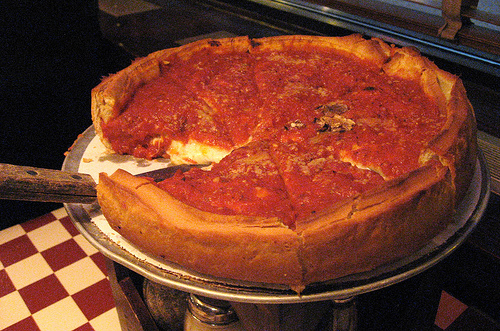
I come from Chicago where we like our pizza thick, the way God intended it. Consequently, it makes sense to me that pizza would be treated as a bread product. Specifically, Customs classified the pizza in 1905.90.90. This is the "other, other" provision in the heading. The statistical suffix at 1905.90.9060 specifically calls out "Pizza and quiche" (not that the statistical suffix means much legally). The applicable rate of duty is 4.5%

From The Pizza Fan (thepizzafan.com)

This should not be (but probably is) true for the wood-fired, crispy-crust, hipster pizza you might find, say, in Brooklyn. It seems to me that would be, at best, a "crispbread" of 1905.10.0000. Just sayin', Brooklyn. I note there are no breakouts under crispbreads. I have, therefore, just legally proven that hipster pizza is, from a legal perspective, not pizza at all. You're welcome, Chicago.

Of course, the practical economic problem is that crispbreads are duty-free. We here in Chicago do not want Brooklyn to have an economic advantage in the imported pizza market. I think we need to petition the President (who is an adopted Chicagoan) to reduce the duty on imported pizza to Free to give Chicago parity with Brooklyn.

Here's another thing I am worried about: do they make a good pizza in Germany? Is this a product we really want in the U.S.? I realize that the tariff item covers more than just pizza. It also covers quiche, corn chips, and other savory snacks. But, for the entire category, Germany was the number seven source of these products. It fell just behind South Korea and just ahead of Israel, neither of which is a pizza dynamo. The number one source of pizza and similar products imported to the U.S. in 2014 was Mexico with the number two slot going to Canada. See, NAFTA works.

Italy, by the way, was number three.

| | | | | | | Devamı » 28 Mart 2015 Cumartesi Unknown 0 yorum