Snuggies Are Blankets

[UPDATED TO ADD LINK TO THE DECISION]

Remember Snuggies? A few years back, they were part of the zeitgeist. Here is a reminder of exactly what is a Snuggie.


According to the commercial, Snuggies are wearable blankets with sleeves-like tubes. That raises an interesting classification question. Is it a blanket of HTSUS item 6301.40.00 (8.5%) or is it a garment classifiable in 6114.30.30 (14.9%)? Or, if it is neither, is it an "other made up article?" The Court of International Trade had to decide that question in Allstar Marketing Group v. U.S.

These are important questions in my world. I get that there is a lot going on in the larger world. Lately, I have been inspired and a little shamed watching lawyers who practice in areas affecting the actual lives and liberty of people, particularly refugees and others trying to entry the country. It made me proud to be a lawyer to see my colleagues set up shop at airports to provide assistance. Yesterday, I was at a meeting sponsored by HIAS Chicago at which an immigration lawyer offered pro bono assistance to arriving refugees. Occasionally, we get to undertake projects for individuals and worthwhile organizations, but that is uncommon in my practice. Here is an example of which I am still proud. Happily, I am currently working on a project that I think will serve the larger public, but it is still in the early stages and will not have the direct, personal impact that we have seen from the good work of immigration lawyers.

Now, back to the wearable blanket.

The evidence presented to the Court of International Trade shows that the importer referred to Snuggies as blankets in communications with the producer-supplier. The marketing materials show people using Snuggies in a variety of settings both in the home and outside, including on an airplane and at a sports stadium. Snuggies have sleeve-like tubes attached to allow users (or are they wearers?) to use their arms freely while still in the comparative warmth of the Snuggie.

The Court found that it had all the information necessary to resolve the matter and that there were no material questions of fact in dispute. That means, the only question is whether Snuggies fit within the common and commercial meaning of the tariff terms "garments" or "blankets." Under Note 2(a) to Chapter 63, if Snuggies are classifiable as garments, they cannot be classified as blankets or other textile items.

Tariff item 6114.30.30 covers "Other garments, knitted or crocheted: Of man-made fibers: other . . . ." There is no dispute that Snuggies are knitted of man-made fibers. The question is, are they "garments?" Looking at the structure of Section XI, the Court found that the items specified in Headings 6101 through 6114 are "garments," which is interchangeable with "apparel." Prior court decisions indicate that apparel is articles that "are ordinarily worn--dress in general." These are "clothes and covering for the human body warn for decency or comfort" as well as adornment. The government argued that because Snuggies are worn for comfort, they are apparel. The Plaintiff argued that because they are not worn for decency and adornment, they are not apparel.

The Court focused on the fact that apparel is "ordinarily worn." Specialized items covered by the apparel provisions include aprons, smocks, clerical vestments, scholastic (and presumably judicial) robes, and certain sports apparel. According to the Court, all of these are more akin to apparel than are Snuggies.

The Court then considered the use of the product. For why, see here. Physically, Snuggies are one-size-fits-all items and are open in the back. These characteristics do not resemble the kind of apparel that is "ordinarily worn." Furthermore, Snuggies were "inspired" by prior existing products called "Slankets" and "Freedom Blankets," both of which were marketed as blankets. Finally, the sales and marketing literature refers to the Snuggie as a blanket. According to the Plaintiff, that makes Snuggies improved blankets.

Blanket is defined as a warm covering used especially on a bed or a similar article used as a body covering for warmth. The Snuggie was designed and marketed as a covering for warmth. Since "blanket" is an eo nomine tariff description, it includes all forms of the article, including improved forms. From that, the Court was able to find Snuggies to be blankets (with sleeves). The addition of sleeves, according to the Court, did not so modify the nature of the article to make it something other than a blanket. The sleeves are incidental to the warming cover that is a Snuggie.

Thus, the plaintiff wins (this round) and Snuggies are classifiable as blankets of 6301.40.00.
| | | Devamı » 13 Şubat 2017 Pazartesi Unknown 0 yorum

Ruling of the Week 2016.12: Avalanche Aribag

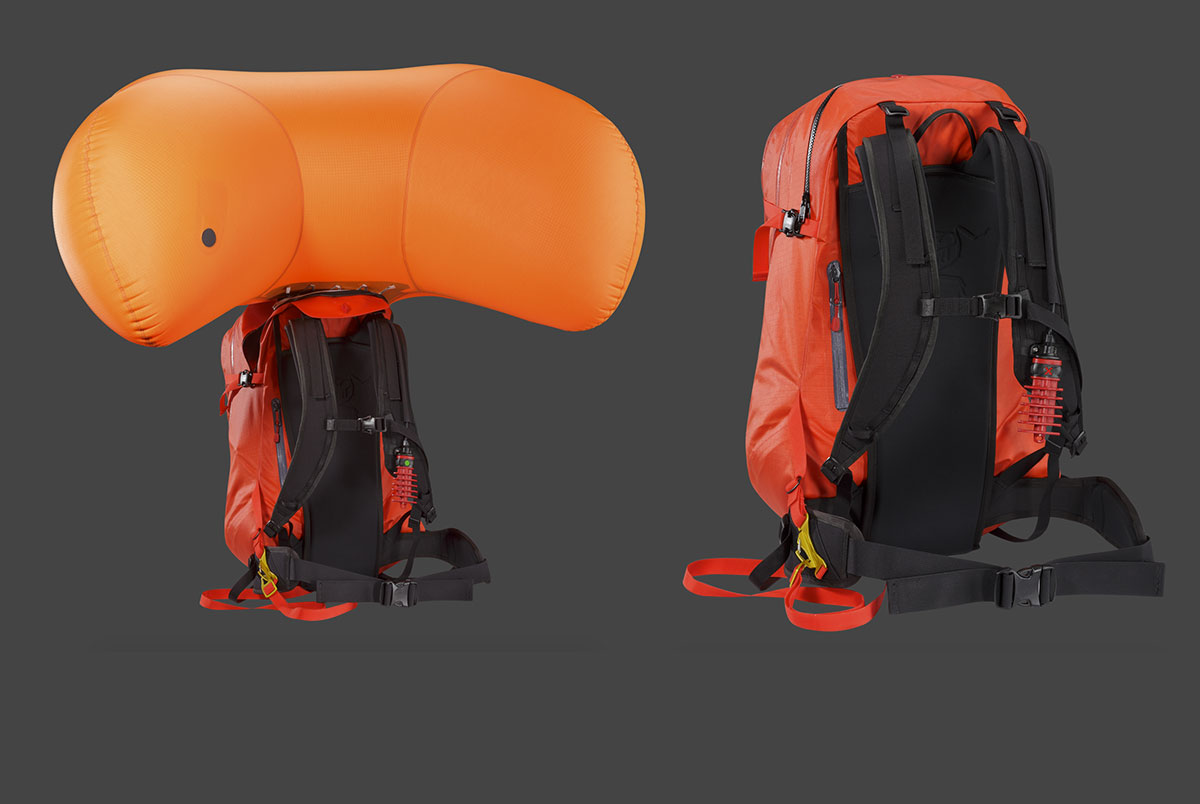
One of the things I find interesting about my job as that I have the opportunity to learn about all sorts of products that I might not ever see in my real life. One such product is the avalanche airbag. It never occurred to me that such a thing existed, but as soon as I read the words "avalanche" and "airbag" together, the concept made perfect sense. This is the item in question:

It is designed to keep the wearer "afloat" in the event of an avalanche. More information about the product is available here. Basically, it is a backpack that incorporates a sturdy balloon and an electrically powered fan to inflate it. Once inflated, the balloon prevents the wearer from being buried in snow.

In NY N274983, Customs was asked to classify this airbag enhanced backpack. My first thought was, "Oh no, this is going in Heading 4202 as a backpack." To me, that seems to undervalue the safety features. Moreover, none of the exemplars in 4202 have safety features. But, that is a straw man I need not fight, because 4202 was not in play. Rather, the importer suggested classification in Heading 9506.99.60 as sports equipment. Customs disagreed with that and noted that the airbag backpack is neither "requisite" not "essential" to any sporting activity.

Instead, Customs classified it in Heading 6307 as an other made up article of textile.

The thing about this device is that it apparently could be worn by anyone in an avalanche-prone area, whether or not participating in a sport. For example, I can see this being worn by the folks who groom and patrol ski runs, by park rangers, and by scientists doing field work. That makes me wonder whether the manufacturer might be able to modify the design to make it clearly dedicated to a sporting event. Customs did admit that it includes exterior straps designed to carry skis, snowboards, and ice axes. Is that enough to make it a product of 9506? Maybe. A more interesting question might be whether there is a clever design tweak that would make it clear that this is a "sporting" product? I don't know what that might be, but I hope the engineers at Arc'teryx are working on it.

Tariff engineering: It's value-added classification.

| | | Devamı » 26 Mayıs 2016 Perşembe Unknown 0 yorum

Ruling of the Week 2015.10: Getting an iHandle on iLuggage

[UPDATE: It turns out that there is a reason for the ambiguity in the ruling discussed below. The ruling was not written for publication. It was inadvertently posted to CROSS. The "ruling" has now been removed. Hence, you should treat what follows as an interesting hypothetical discussion and nothing more.]

Heading 4202 of the Harmonized Tariff Schedule of the United States sees lots of legal action for two reasons. First, the duty rates are very high; some as high as 20%. Second, U.S. Customs and Border Protection seems to find that many items go in these high-duty provisions.

For context, Heading 4202 covers:

Trunks, suitcases, vanity cases, attache cases, briefcases, school satchels, spectacle cases, binocular cases, camera cases, musical instrument cases, gun cases, holsters and similar containers; traveling bags, insulated food or beverage bags, toiletry bags, knapsacks and backpacks, handbags, shopping bags, wallets, purses, map cases, cigarette cases, tobacco pouches, tool bags, sports bags, bottle cases, jewelry boxes, powder cases, cutlery cases and similar containers, of leather or of composition leather, of sheeting of plastics, of textile materials, of vulcanized fiber or of paperboard, or wholly or mainly covered with such materials or with paper . . . .

There are two distinct parts to this heading. The first part, before the semicolon, does not depend on material. The second part only includes items that are of leather, plastic sheeting, textiles, etc. Both sections list many examples of containers and end with the expression "and similar containers." That is where things get interesting and problematic.

I am talking about this because it is endlessly fascinating, because I have litigated this issue, and because of HQ H163995 (May 19, 2014), which involves the classification of iPod covers or possibly neoprene covers for laptop computers. There is, at least to my mind, some ambiguity as to the merchandise. I am going to assume it is iPod covers.

Customs classified them in Heading 4202 and Target, the importer, protested. According to Customs, the proper classification is as articles of plastic in Chapter 39. The problem for Target is that Note 2(m) to Chapter 39 states that "This chapter does not cover . . . trunks, suitcases, handbags or similar containers of heading 4202." If the laptop covers are similar to trunks, suitcases, and handbags of Heading 4202, they cannot be classified in Chapter 39.

Because the laptop covers at issue are not leather, plastic sheeting, textiles, vulcanized fiber, or paperboard, if they belong in 4202, it will be in the first section as containers "similar to" trunks, suitcases, vanity cases, etc.
Ticking off the necessary elements, Customs first made the unsurprising but necessary conclusion that the iPod covers are containers. This was based on dictionary definitions stating that a container is something that can hold together, hold, or contain an article.

The bigger issue was whether the iPod covers are "similar to" the containers listed in the first part of Heading 4202. To do this, Customs properly invoked the cannon of statutory construction "ejusdem generis," which is Latin for "same kind." Under this rule, the general phrase "and similar containers" is interpreted as limited to containers that share the same  essential characteristics or purposes with the listed articles. The courts have previously held that the essential characteristics and purposes of the items listed in Heading 4202 are that they "store, organize, protect, and carry" the items contained therein.

The meaning of "store" and "organize" were worked out in a case called Firstrax. That case is worth reviewing if only because it is one of mine. It involved fabric pet crates. The Court of International Trade found that a single item, including a living pet, cannot be organized. Organizing is the act of putting multiple items in some kind of useful order.  A pet is also not stored, because storage is the act of putting something away for later use.

In this case, the iPod covers hold one device. Consequently, they do not provide organization. Furthermore, the covers include opening to allow the user to operate the controls on the iPods. Since the iPod is not being put away for later use, the covers do not "store" the iPods. Two down.

Target acknowledged that the covers protect the iPods from scratches and from impact in the event they are dropped. Target also seems to have acknowledged that the grippy material facilitates securely carrying the iPods. That means that the covers serve to protect and facilitate carrying.

That was enough for Customs and Border Protection to find that the iPod covers are properly classifiable in Heading 4202 and, therefore, excluded from Chapter 39.

I have some concerns about this decision. First, how exactly do the exemplars in the first part of Heading 4202 facilitate carrying the items in the container? With the exception of spectacle cases, they all have a handle. I think this is important in that it helps define how we should interpret what it means to facilitate carrying something. All of these cases take something that is unwieldy (clothing and personal effects) or delicate (a musical instrument or binoculars) and make carrying the item or items practical by the addition of a handle to something that does not otherwise have a handle. That is not the case with respect to an iPod case, which makes the iPod no easier to carry. The grippiness of the case is, at best, incidental, since the user still has to carry the iPod in much the same way it would be carried without the case.

The inclusion of spectacle cases does not change that analysis. Glasses are hard to carry safely without a case. They bend and scratch easily. The case makes it easier to carry glasses in a meaningful way (even without a handle).

So, it seems to me that the "carry" part of the "store, organize, protect and carry" test must mean that the item would not be easily carried but for the case. The iPod cases doe not seem to satisfy that requirement.

Is it enough if all the cover does is protect the contents? Personally, I think not. This is the second question. Customs, following some court cases, says that any one of the four criteria is sufficient to classify something in Heading 4202. I don't agree. Trunks, suitcases, vanity cases, etc. do all four of those things. I think what we have here is a semantic argument that has lost sight of the original ejusdem generis analysis. Nothing in the first part of Heading 4202 is exclusively protective without also helping to transport the articles inside. It seems to me that you need at least those two items together to be ejusdem generis with trunks, suitcases, spectacle cases, etc.

Lastly, I wonder whether it is correct to say that an iPod cover contains the iPod when it has opening to allow access to the controls. The cover certainly envelopes the iPod, but the iPod is exposed to the elements in a way that is not true for musical instrument cases, for example. When I was in high school carrying a bass clarinet from home to school, I could not play the instrument while it was in the case. That strikes me as very significant.

This issue will surely be before the Court of International Trade at some point. It looks to me to create the opportunity to further clarify what "carry" and "protect" mean in the context of Heading 4202. More important, it looks like a good opportunity to reverse course and recognize that protection alone is not enough to be ejusdem generis with the exemplars of Heading 4202.
| | | | Devamı » 22 Mart 2015 Pazar Unknown 0 yorum

Best Key Overturned

With this post, I am momentarily caught up.

Best Key Textiles Co. Ltd. v. United States has been a bit convoluted from the get go. The company makes, but does not import, metalized polyester yarns. It got a ruling from Customs and Border Protection that classified the yarn in HTSUS item 5605.00.90, which has a rate of duty of 13.2% ad valorem. Armed with this, Best Key got a second ruling on a "pullover garments" called a "Johnny Collar." Best Key's strategy seemed to be to confirm that it was making metalized yarn of 5605.00.90, which has a relatively high rate of duty, and then confirm that apparel made of that yarn would be subject to a relatively lower rate duty applicable to apparel of "other textile materials." Incongruously, Customs classified the Johnny Collar as being of polyester, thereby giving it a higher 32% rate of duty.

Best Key requested that Customs review the Johnny Collar classification. In doing so, it also reviewed the yarn classification. In a blow to Best Key, Customs revoked both rulings. It determined that the yarn was improperly classified and re-classified it as polyester yarn. Polyester yarn has a lower 8% rate of duty. The Johnny Collar ruling was also revoked and replaced, but the classification stayed the same.

That means that Best Key's actual product, if imported as is, receives a lower rate of duty. Usually that is a win for the manufacturer. Here, it is not. Best Key does not import yarn. It sells yarn to foreign producers who sell garments to be imported to the U.S. If the yarn is metalized, the garments receive a lower rate of duty. Ultimately, that is the win Best Key wants.

In the Court of International Trade, Best Key challenged the ruling revocation on the Johnny Collar, which it does not make or import. Initially, the Court said that Best Key had not established jurisdiction in the Court, but it later changed that position and reviewed the case on the merits. The CIT based it jurisdiction on 28 USC 1581(I)(4), which is a residual provision granting the CIT exclusive jurisdiction over actions commenced against the United States that arise out of any federal law providing for "administration and enforcement with respect to," among other things, revenue from imports, tariffs, and duties.

In this appeal, the United States argued that the CIT was correct that first time and the lower court never had jurisdiction over Best Key's claims. The opinion, by former CIT Judge Wallach, agrees with the United States. As a result, the CIT decision is vacated and remanded to be dismissed.

As the courts have stated repeatedly, the primary means of securing jurisdiction for review of a tariff classification is through a denied protest and then a summons under 28 USC 1581(a). If that avenue is available, the would-be plaintiff cannot get into the Court of International Trade on another basis (with a few exotic exceptions). Here, 1581(a) the protest avenue was available and not "manifestly inadequate" as a means of relief. According to the Federal Circuit, "any producer who imports items made from Best Key's yarn and believes the merchandise should be subject to a lower duty rate should protest the classification and challenge any denial of its protest before the CIT." Moreover, it would appear that Best Key could do that it imported a bunch of Johnny Collars on its own account and protested the liquidations.

There was another possibility for Best Key. Under 28 USC 1581(h), a party can challenge a pre-importation ruling if the party can demonstrate that it will be irreparably harmed unless given an opportunity for review. This sounds good, but does not help Best Key. Best Key was not harmed by the ruling on its product. Rather, at least according to the Court of International Trade, the ruling on yarn favors Best Key's product. The real issue is the potential harm a potential importer of a potential product made from Best Key's metalized yarn. In other words, Best Key, is on indirectly harmed and is trying to protect the rights of strangers to the case. There is, therefore, no "case or controversy" involving Best Key and, under pesky Article III of the Constitution, no case to be had.

Because the CIT did not proceed on the basis of (h) jurisdiction, the Federal Circuit did not address it. But, the same rule applies. If the party can avail itself of a protest and (a) jurisdiction, it needs to do so.

Personally, I wonder about that in this case. Since Best Key admits that it neither makes nor imports apparel, should it be required to do so to manufacture (a) jurisdiction? This indirect injury as the result of a prospective ruling seems to be exactly the kind of thing that makes (a) unavailable or inadequate. There is no way to quantify how much damage will be done to Best Key as a result of the Johnny Collar ruling leading its customers to other yarns. That is irreparable harm. I think (h) might deserve a second look.

Please, can I have a week or so without any new customs decisions?
| | | | Devamı » 6 Şubat 2015 Cuma Unknown 0 yorum

Quoth the Blogger, "Skidmore?"

Continuing my effort to catch up with the Court of International Trade and one decision of the Federal Circuit, we now come upon JBLU, Inc. v. US, a recent decision of the Court of International Trade.

The issue in this case is whether wearing apparel from China bearing the brand-name "C'est Toi Jeans Los Angeles," "CT Jeans USA," and "C'est Toi Jeans USA" were properly the subject of a Notice to Mark or Redeliver for failure to have adequate country of origin marking. Customs and Border Protection maintains that the use of "Los Angeles" and "USA" on the labels requires the there be in close proximity and in comparable size a a country of origin marking preceded by "Made in," "Product of," or another similar phrase. This requirement comes from 19 CFR 134.46,

The importer maintains that section 134.46 does not apply because the geographical designations are part of a trademark or trade name. That argument comes from 19 CFR 134.47.

The nub of the issue comes down to whether Customs' definition of "trademark" for purposes of interpreting the regulation is correct. Customs applies the trademark regulation only to registered trademarks or where there is a pending application to register a trademark. The importer claims the regulation applies to trademarks under federal law as well as common law trademarks, which are unregistered but used in commerce. A federally registered trademark is denominated with the (R) symbol while a common law trademark sometimes gets marked with the letters TM.

To cut to the chase, the Court upheld Customs' interpretation and found that to the extent there was no pending application to register the trademarks at the time of some of the entries, the Notice to Mark or Redeliver was a valid exercise of CBP authority as to those entries.

I do have a question to raise respectfully. According to the Court of International Trade, in the absence of a definition of "trademark" in the regulation, the Court must "give Customs' interpretation of 19 C.F.R. [sec] 134.47 substantial deference, unless it is 'plainly erroneous or inconsistent with the regulation.'" For that proposition, the Court cites Supreme Court precedent and a Federal Circuit case involving a review of a dumping determination.

In the context of the de novo review of the denial of a protest, would it have been appropriate for the Court to also or instead apply Skidmore deference to CBP's determination? In that event, the Court would have to decide whether CBP's decision has the power to persuade the Court.

The decision notes that Customs' position is consistent with prior rulings and with the purpose of the marking law. Thus, I think the Court is basically saying that Customs' legal interpretation is persuasive and passes muster even under the somewhat looser Skidmore standard. That means the result is the same no matter how the Court cuts it. So all I am talking about is the label put on what the Court did.

With apologies to Edgar Allen Poe.