Ruling of the Week: 2017.8: To Drawback, And Beyond!

The customs implications of space travel have always interested me. NASA has confirmed, at least according to this article, that astronauts have to make customs declarations on returning to earth. It is not exactly clear to me whether that would be the case for an orbital flight that departs the U.S. and returns to the U.S. without an intervening stop at the International Space Station or elsewhere. In fact, the Apollo 11 customs entry seems to have been something of a joke, even if it was "official."

The future is certainly going to be filled with questions about this sort of thing. What will happen, from a customs-perspective, the first time someone starts a commercial asteroid mining operation? Will we need to expand the notion of "country of origin."

The obvious analogy is to ships at sea. Today, the law is clear with respect to fish caught in international waters. According to the Court of International Trade, in a case called Koru North America v. U.S.:

On the high seas, the country of origin of fish is determined by the flag of the catching vessel. Procter & Gamble Mfg. v. United States, 60 Treas. Dec. 356, T.D. 45099 (1931), aff'd, 19 CCPA 415, C.A. D. 3488, cert. denied, 287 U.S. 629, 53 S.Ct. 82, 77 L.Ed. 546 (1932). In international law, a ship on the high seas is considered foreign territory, functionally, "a floating island of the country to which [it] belongs." Thompson v. Lucas, 252 U.S. 358, 361, 40 S.Ct. 353, 64 L.Ed. 612 (1920). See also Robbins (Inc.) v. United States, 47 Treas. Dec. 261, T.D. 40728 (1925) (fish are characterized by their first taking).
That means an asteroid or portion thereof brought to the earth by a U.S.-registered space vessel will have a U.S. country of origin.

The folks who negotiated NAFTA thought this through. According to Article 415 of the Agreement, "goods taken from outer space, provided they are obtained by a Party or a person of a Party and not processed in a non Party" are considered to be "wholly obtained or produced" in North America. For you NAFTA nerds out there, that means they qualify as originating under Preference Criterion A.

What about going the other way? What if I import some fuel and send it out into orbit? Does that constitute exportation for purposes of drawback? That is the question presented in HQ H282698 (Feb. 24, 2017).

The law permits an importer receive drawback on duties, taxes, and fees paid on imported merchandise that it unused in the united stated and then exported or destroyed within five years of importation. There are lots of documentary requirements and procedures that need to be followed to secure drawback, so don't assume that I just explained all the ins and outs to you.

Merchandise is still unused if it has been repacked or subjected to other operations specified in the law. Again, don't try this at home without getting legal advice. In this case, about 66% of the fuel is loaded onto the satellite to power its thrusters in orbit. The remainder is exported from the U.S. According to CBP, transferring the unused propellant to a container for export is repacking and does not constitute use. It is, therefore, eligible for drawback.

The propellant loaded into the satellite is a different story. According to CBP, it is "used at the moment of its injection into a satellite thruster system." It is, therefore, not eligible of "unused merchandise" drawback.

Customs, however, provides a helpful alternative. It is also possible to secure drawback on imported materials used to manufacture goods in the U.S. CBP has previously applied that to parts of a satellite manufactured in the U.S. and exported to China for launch. That export to China was the relevant export for drawback purposes, not the launch into space. But, other rulings had determined that "merchandise assembled into a communications satellite sent into permanent orbit in outer space" is exported for drawback purposes. In this recent ruling, CBP reaffirmed that decision and held that launch to permanent orbit is an exportation for drawback purposes.




| | Devamı » 22 Mart 2017 Çarşamba Unknown 0 yorum

Ruling of the Week: 2017.7: Our Lady of Guadalupe in Wood

Customs law is an interesting practice because we get to see all of the interesting things that come into the country. Granted, a lot of it is pieces of machinery, chemicals, and goods for resale. Now and again, something strange or unexpected shows up. Couple that with my belief that the Harmonized Tariff Schedule of the United States provides the legal means of determining important philosophical questions such as whether something is art or is holy. These questions are, sort of, the issue in HQ H136955 (Aug. 6, 2014), which for some reason was only recently published.

The merchandise at issue is the 3/4 round depiction of Our Lady of Guadalupe with surrounding rays of light. The issue is whether this is a statuette or ornament of wood of HTSUS heading 4420, an original sculpture of Heading 9703, or an article for use by a religious institution of HTSUS item 9810.00.25.


The starting place for this analysis is that Note 1(r) to Chapter 44 excludes works of art of Chapter 97. That means the first philosophical question to be addressed is whether the above depiction of Mary is a work of "art" as opposed to a commercial craft. While artists, collectors, curators, and academics might argue that the definition of art is profoundly subjective, Customs does not work that way.

To be classifiable in Heading 9703, the item must be an "original" sculpture, ancient or modern. That excludes decorative items of conventional craftsmanship of a commercial nature. That means the random coconut carved into the head of a monkey is not likely to be "art" by this definition because the workmanship is conventional and commercial. Court cases have held that a statue is original if the artist exercised his or her own aesthetic imagination and artistic conception when creating the work.

It turns out that this image is basically a three-dimensional copy of images dating back to 1531. Stick with me here as I am way out of my comfort zone. In 1531 Mary appeared to Juan Diego. After the event, his cloak was miraculously imprinted with a version of the image depicted in the statue and also "countless" similar depictions. See, for example, this image of Juan Diego from Catholic.org:


And here is the "original:"


You can see that the imported statue does not show a lot of aesthetic imagination or artistic conception. Consequently, CBP declared it to not be "art." Also, there was no evidence presented establishing the identity of an artist who might have exercised some artistic imagination. That prevents classification in 9703.

What about 9810.00.25? This is an interesting question. The tariff item covers:
Articles imported for the use of an institution established solely for religious purposes:
Articles imported for the use of an institution organized and operated for religious purposes, including cemeteries, schools, hospitals, orphanages and similar nonprofit activities staffed and controlled by such institution:
Altars, pulpits, communion tables, baptismal fonts, shrines, mosaics, iconostases, or parts, appurtenances or adjuncts of any of the foregoing, whether to be physically joined thereto or not, and statuary (except granite or marble cemetery headstones, granite or marble grave markers and granite or marble feature memorials, and except casts of plaster of Paris, or of compositions of paper or papier-mâché)  

According to CBP, articles classifiable in this tariff item must be subject to a pre-importation sale to a religious institution. Here, it appears the item may have been sold to a church, but there is a failure of adequate proof. There is an inconsistency between the commercial invoice, which describes a 3/4 round statue, and the purchase order, which describes a fully round statue. Other documents do not list the church as party to the transaction. In addition, the entity listed as the importer is a re-seller of this type of merchandise and maintains an inventory of similar statues. IMports for re-sale would not fall within this tariff item.

As a result, Customs was not convinced that this particular statue was destined for use by a religious institution. Customs, therefore, rejected the possible classification in Heading 9810.

The statue of Our Lady of Guadalupe was, therefore, classified in tariff item 4420.10.00 with a 3.2% rate of duty.


| | | | Devamı » 28 Şubat 2017 Salı Unknown 0 yorum

Ruling of the Week 2017.6: Printers vs. Printing Machines

This one will be quick, for lots of reasons. Mostly, I don’t have much to add to the ruling other than a question. The ruling at issue is HQ H128416 (Feb. 9, 2017). It involves the tariff classification of digital wide-format ink-jet printer used to print and cut vinyl graphics for outdoor advertising and similar applications.

The printer is a combination of a printing machine and a cutting machine. As such, the competing tariff provisions are in Heading 8443 (Printing machinery) and 8477 (Machinery for working rubber or plastic). That is the sole question addressed in the ruling.


To resolve the classification, Customs and Border Protection applied Note 3 to Section XVI of the HTSUS, which states in relevant part:

Unless the context otherwise requires, composite machines consisting of two or more machines fitted together to form a whole and other machines designed for the purpose of performing two or more complementary or alternative functions are to be classified as if consisting only of that component or as being that machine which performs the principal function.

According to the importer, the principal function is printing, making the machine an article of 8433. Customs agreed, finding that the machine would not be used solely for cutting but that it might be used for printing without cutting. Customs examined the factors set out in United States v. Carborundum Co., 63 C.C.P.A 98, 536 F.2d 373 (1976), including physical characteristics, channels of trade, expectation of the ultimate purchaser, and recognition in the trade to ultimately agree that this machine is primarily a printer.

OK, so here’s my question: Why not consider this to be an 8471 unit of an automatic data processing machine? In other words, why is this ink-jet printer different than the ink-jet printer on my desk? The difference between 8471 printers and 8443 printing machines was discussed at length by the Court of International Trade in Xerox, which we reviewed here. The ruling states that these are “digital” printers. That means that they function in conjunction with a computer to translate digital data into signals to the printer. The only difference is that they print on large format plastic rather than on paper and they can cut the plastic. Once we determine that printing is the principal function, it seems to me that the cutting becomes irrelevant. What we know from Xerox is that large scale digital printing is still a data processing function. That would make these printers units of ADP machines of Heading 8471.


I am probably wrong for some factual reason not stated in the ruling. Heck, I may be wrong on the legal analysis. My analysis ends up with the potentially absurd result that all digital printers are ADP machines and 8443 printing machines would cover only Gutenberg-style presses and similar analog machines. It would be nice to know whether this was discussed and how it was decided that 8471 is not relevant.
| | | Devamı » 24 Şubat 2017 Cuma Unknown 0 yorum

Ruling of the Week 2017.5: Copper Scrap

There are a number of Chapter 98 tariff items that permit partial duty exemptions for items of the United States that are sent abroad and returned to the United States. Given the current trade rhetoric, it might be worth explaining why that is the case. After all, why give a benefit to companies that send goods abroad for further processing? The short answer is that the duty exemption encourages the use of U.S. origin materials in manufacturing abroad. After all, if there is going to be manufacturing abroad, the U.S. should encourage that it take advantage of U.S.-origin components and materials. The alternative is to manufacture abroad entirely from foreign components.

The HTSUS item at issue in HQ H281950 (Jan. 26, 2017) 9802.00.60, which provides a partial duty exemption for:
Any article of metal (as defined in U.S. note 3(e) of this subchapter) manufactured in the United States or subjected to a process of manufacture in the United States, if exported for further processing, and if the exported article as processed outside the United States, or the article which results from the processing outside the United States, is returned to the United States for further processing . . . .
To qualify, the metal article must be manufactured in the United States. The question presented in this ruling is whether scrap metal collected from industrial production in the U.S. is "manufactured in the United States." The scrap metal at issue here is copper. The question is potentially complicated by the fact that some of the original copper was domestic in origin while some was originally foreign. Some of the scrap will be derived from production processes. Some will just be collected in the form of obsolete U.S-origin wire.

From exportindia.com


 The tariff does not define "manufactured" in this context. In prior rulings, CBP has held that metal is manufactured when it is subject to operations such as "splitting, annealing, milling, rolling, brushing, and leveling." Here, the industrial scap results from the application of those manufacturing processes to copper. As a result, Customs held that the scrap was also manufactured in the U.S.

Customs has also held that the process of making metal into U.S.-origin products is sufficient manufacturing to allow used, obsolete products to be considered manufactured in the U.S. [Note: I realize that seems self-evident, but that's the fact of the matter.]

Consequently, in this case, all of the goods, when re-entering the U.S. after further processing abroad, qualify for the partial duty exemption. There are, of course, documentation requirements. If you are going to try this, look at 19 C.F.R. 10.9.


| | | Devamı » 5 Şubat 2017 Pazar Unknown 0 yorum

Ruling of the Week 2017.4: Midwakh from UAE

This is a good week to be talking about trade with the Middle East. I am talking about trade in goods, which is what I do. I don't talk about immigration issues. That's too bad because yesterday was a doozy of day in the history of immigration law in America. Congratulations to the ACLU and everyone who helped secure a stay of the President's order barring entry for people from seven majority-Muslim countries (including those already holding green cards and visas). That was a tremendous effort at ensuring the rule of law, not to mention humane treatment for people who had the bad luck of being on a plane at the moment he signed the order. There were many examples of lawyers showing up at airports around the country to help stranded travelers. Some of them were affiliated with the International Refugee Assistance Project. Both the ACLU and IRAP deserve your support.

That said, I will focus on something entirely superficial: the customs treatment of mewakh pipes.

From Medwakh.com
These are small wooden pipes that, in N257162 (Oct. 3, 2014), Customs and Border Protection described as being "of Arabian origin." That puts me in mind to watch Lawrence of Arabia and makes me wonder why they were not described as originating in the United Arab Emirates, which is what the facts state.

These are pipes traditionally used in the region to smoke dokha, which is a blend of tobacco, other leaves, bark and herbs. Dokha can also be flavored with fruit.

According to Customs and Border Protection, the pipes are classifiable in 9614.00.2500, not surprisingly, as "smoking pipes . . . of wood . . . ."

In the ruling, CBP made a couple useful observations. First, dokha of Iranian origin is probably subject to sanctions and not admissible into the United States. That seems to have been a complete aside as there is no indication that dokha was the subject of the ruling. But, I am not being sarcastic, that extra bit of information may have been useful to the ruling requester.

Second, CBP noted that the importer might want to look into whether the medwakh constitute drug paraphernalia, which would also not be admissible. Under 21 U.S.C. § 863, it is unlawful to sell or transport drug paraphernalia. But, under subsection 21 U.S.C. § 863(f)(2), the prohibition does not apply to “any item that, in the normal lawful course of business, is imported, exported, transported, or sold through the mail or by any other means, and traditionally intended for use with tobacco products, including any pipe, paper, or accessory.” That standard has come to mean that Customs looks to whether the imported item is primarily intended for use with illegal drugs, including a review of the labeling, instructions, marketing, display, etc. Under that standard, a mirror might be treated as drug paraphernalia if it is etched to depict razor blades, tiny spoons, and rolled dollar bills. [Note to my parents: The only reason I thought of those particular items is because I have seen Scar Face one too many times. Really.] For more on this, see HQ H150766 (Mar. 8, 2011)(holding that hookas area not drug paraphernalia).


| | Devamı » 29 Ocak 2017 Pazar Unknown 0 yorum

Ruling of the Week 2017.3: Indirect Materials

I do a lot of NAFTA-related work. At least I do this week. It remains to be seen whether that changes soon. Secretary of Commerce designee Wilbur Ross told the Senate committee considering his nomination that his top priority would be renegotiating NAFTA. So, this may all change. As we sometimes have to tell clients, the situation is fluid.

In the meantime, the NAFTA rules of origin continue in place. Often, for a product to qualify as originating, it must have a Regional Value Content of 50% when calculated with the net cost methodology or 60% when calculated with the transaction value methodology. There are exceptions, especially for automotive products. You need to check the rule applicable to your product in HTSUS General Note 12.

Sometimes, producers are close but cannot hit the required RVC. There are a few means provided in the regulation for adding to the RVC. One of the best is the designation of a self produced material as an intermediate material. HQ H273100 (Jan. 6, 2016) is a good example of how that works.

The producer was making starter motors for lawn tractors in Mexico. As part of that process, it also made the DC motor at the heart of the starter motor assembly. The starter motor is classified in 8511.40.00 and is subject to an RVC requirement because not all of the non-originating materials make a required tariff shift under the applicable rule.

The DC motor is classified in 8501.32. If the producer thinks just about the finished motor assembly, all of the non-originating materials in it make a qualifying change in tariff classification. That means the motor would, if certified separately, qualify as originating.

The useful thing to know here is that Part III, Section 6(4) of the NAFTA Rules of Origin Regulations provides (in relevant part):

Except as otherwise provided in section 9 and section 10(1)(d), for purposes of calculating the regional value content of a good under subsection (2) or (3), the value of non-originating materials used by a producer in the production of the good shall not include

the value of any non-originating materials used by the producer in the production of a self-produced material that is an originating material and is designated as an intermediate material.

As a result, and as Customs and Border Protection confirmed in this ruling, the value of non-originating materials used in the production of the motor are not counted toward the value of non-originating materials when doing the RVC calculation for the starter motor. It does go in the net cost. That means, the total value of the motor is treated as originating, despite containing non-originating materials.

This rule makes perfect sense. The motor sub-assembly could have been purchased from a third party. If that third party used exactly the same supply chain and production process, it would have been able to certify the motor as originating. The purchaser of the DC motor would not have been penalized for any non-originating material in the motor. The intermediate material rule recognizes that a vertically integrated manufacturer should not be at a disadvantage.

The wrinkle here is for automotive goods. The references in the regulation to section 9 and section 10(1)(d) cover that. For light-duty automotive goods, the net cost methodology is modified to require a higher RVC and "tracing." Tracing means that the value of non-originating materials includes the value of certain designated materials, even if they are in a sub-assembly. That non-originating value must be captured and brought forward for the RVC calculation. A similar limitation applies to heavy-duty automotive components, component-assemblies, and sub-components.

If you are having trouble getting to the required RVC, look for self-produced sub-assemblies in your bill of materials. There may be enough value there to get your product over the hump.
| | Devamı » 22 Ocak 2017 Pazar Unknown 0 yorum

Ruling of the Week 2017.2: Emergency War Material Covers Failed NAFTA Claim

I like this ruling. It is HQ H273101 (Nov. 4, 2016).

This is a case where the importer made a NAFTA claim. When asked by Customs and Border Protection, the importer either could not or just did not support the claim. It happens. Sometimes, subsequent review turns up a problem with the NAFTA documentation. Sometimes, the broker should not have made the claim to start with. Lots of things happen in the real world.

This particular product is a multi-sensor electro-optical surveillance and targeting turret from Canada. As you might imagine, a multi-sensor electro-optical surveillance and targeting turret is a piece of military equipment. When the NAFTA claim failed, the importer asserted that the merchandise is entitled to duty-free entry as war material certified as such by a military procuring agency under HTSUS item 9808.00.30. It submitted the necessary certificates.

Customs liquidated the entry at the applicable 4.5% rate of duty and the importer protested. Customs granted the protest. It noted that in the absence of willful negligence or fraudulent intent, the importer can, prior to liquidation, submit documents to support a claim for free or reduced duties. The regulation that supports this is 19 CFR 10.112. Note that the regulation allows for the documents to be submitted even after liquidation but before the liquidation is final. That is a narrow window of 90 days following liquidation. See 19 USC 1501.

Why do I like this rulings? It is not just because the importer won. It is also because the importer, or its counsel, took a step back from a problem, surveyed its options, and found a creative solution. I also like it because it reaffirms for importers and brokers that the filing of the entry is not necessarily the end of the process. If there is a better option or a way to reduce duties after the entry summary has been filed, go ahead and submit the appropriate documents. There is money to be saved, go save it.
| | | | | Devamı » 13 Ocak 2017 Cuma Unknown 0 yorum

Ruling of the Week 2016.23: Patents and Value

We don't talk enough about customs value here. It is important, complicated, and interesting. It deserves more attention. There are, however, also fewer rulings and cases on valuation questions. Happily, this one (HQ H233376, Sep. 19, 2016) caught my eye. The issue is whether a royalty paid to a U.S. patent holder who is unrelated to the importer is dutiable when the royalty is paid not by the importer but by the importer's parent company.

The patents at issue are all utility patents, meaning that they relate to new and useful inventions rather than to the design aesthetics of the item. A utility patent generally involves the critical technology that defines or empowers the invention. The license grants to the importer (via a predecessor company, just to complicate matters) "to make, have made, use, sell, offer for sale and import Licensed Devices" worldwide. The license also authorizes the licensee to disclose to the manufacturer, who is in Malaysia, the information that is necessary to manufacture the products. Similarly, the manufacturer is authorized to use the patented technology to makes the item and to apply related trademarks.


When goods are imported pursuant to a sale, the customs valuation is usually the "transaction value." That is defined at 19 USC 1401a(b) as the price actually paid or payable for the merchandise when sold for exportation to the United States, plus specified statutory additions including "any royalty or license fee related to the imported merchandise that the buyer is required to pay, directly or indirectly, as a condition of the sale of the imported merchandise for exportation to the United States."

In 1993, Customs published an official notice detailing how it will analyze royalties for dutiability. We discussed that here. To summarize from my earlier post, under the test, Customs and Border Protection analyzes each royalty agreement on a case-by-case basis and asks three questions:

1. Was the importer merchandise manufactured under patent? If the answer is yes, then the payment is more closely tied to the production of the merchandise and is, therefore, more likely dutiable.

2. Was the payment involved in the production or sale of the imported merchandise? This question goes more deeply into the purpose of the payment. If the importer can show that the payment is for something other than the manufacture, production, or purchase of the imported goods, the payment may not be dutiable. Customs gave two examples in which the Court found that the putative royalty was for the use of the product in the United States, not for the patent rights related to the production or importation of the product. A positive answer to this question, therefore, leans toward dutiablity while a negative answer leans against.

3. Could the importer buy the product without paying the fee? If the fee is not optional and goes to the seller, it is more likely to be a dutiable part of the value of the merchandise. According to Customs, this question "goes to the heart" of whether the payment is a condition of sale. That means a negative answer to this question indicates dutiability.

In this ruling, Customs gave the short answer that the royalty is dutiable. The merchandise was manufactured under a patent and the patented technology is related to the production or sale of the imported item. Furthermore, Customs found that the importer could not buy the merchandise without paying the fee. Nevertheless, counsel for the importer (who was not me) argued against suitability of the royalty in this case.

Counsel first noted that the royalty is not paid to or for the benefit of the seller. This is a common argument and merits attention. How is a royalty part of the "price paid or payable" for the merchandise if it not paid to the seller? The answer is that the statute does not require that the royalty be paid to the seller to be dutiable. Rather, the statute requires that royalties be added to the dutiable value when they are "related to the imported merchandise" and when "the buyer is required to pay [the royalty], directly or indirectly, as a condition of the sale of the imported merchandise for exportation to the United States." Note that the statute does not say to whom the royalty must be paid to be dutiable.

The question is not how much did the seller receive in exchange for the goods. The question is what is the total cost to the buyer to acquire the merchandise. This is entirely consistent with other parts of the statute which, for example, add assists, selling commissions, and packing materials to the entered value for duty. If the buyer did not pay this patent royalty, the seller would have to do so to acquire the legal right to manufacture the item. Because the buyer's parent paid it, the cost to the seller is reduced below what it would otherwise have been. This is exactly why the value of buttons provided by the buyer to the manufacturer for use in the production of shirts must be added to the entered value of the shirts. If the seller had to go buy the buttons, it would increase the price to cover the additional expense. This, therefore, is a losing argument, even when the patent holder is in the U.S.

To stick to this conclusion, Customs had to distinguish several prior rulings that appear to have conflicting results. I'm going to spare you the details. It should suffice to say that a patent royalty might not be dutiable if it is not a condition of the sale to the United States or is not fundamental to the manufacturer of the item. For example, a patent license relating only to the use of some item, as opposed to the manufacturer of it, is less likely to result in a dutiable royalty. Similarly, a design patent is less likely to be dutiable than is a utility patent.

The other question is whether a royalty paid to a U.S. patent holder can be a condition of the sale for export from the foreign manufacturer. After all, what does the manufacturer care if the buyer fails to pay the royalty? That is not its problem. Customs' analysis is more nuanced than that. It held that a condition of the sale exists where the right to use the patent "must be secured, either by the buyer or the manufacturer because the patent is necessary to produce the merchandise to be sold for export to the United States. i.e., [sic] the imported merchandise would not exist it the rights to the patent were not obtained." This gives the requirement that the royalty be a condition of the sale a broad and flexible interpretation that can be interpreted practically as well as under the terms of an individual contract.

All of that led Customs and Border Protection to hold the royalty in this case to be dutiable.

I have a question. The ruling clearly says, "the royalty payments at issue are made to the licensor, [Company A] (a U.S. patent holder who is not related to the company or to the manufacturer of the imported merchandise_, by [Company B], the parent of the company's parent." [Emphasis added.] So am I correct that the buyer did not actually pay this royalty? It was paid not by the parent company but by the grandparent company. This should be discussed in the ruling. The company, presumably the importer, is not responsible for the payment of the royalty. It seems possible that the company did not even know about it.

The statute covers "any royalty or license fee related to the imported merchandise that the buyer is required to pay, directly or indirectly, as a condition of the sale . . . ." [Emphasis added.] It appears that Customs treated the royalty as indirectly paid, without stating so. Is that right?

I would read "indirectly" as relating to the method of payment to the seller, not to the party making the payment, which seems to be limited to the buyer. How do we know from this ruling that the buyer is required to make this payment, whether directly or indirectly? It seems clear that a related but legally separate entity is required to make that payment. I can see CBP's implied conclusion that this is an indirect payment by the buyer, but I think there needs to be some facts stated to support that conclusion. Otherwise Customs has effectively ignored the separate legal status of the companies and pierced a corporate veil without comment.


| | Devamı » 4 Aralık 2016 Pazar Unknown 0 yorum

Ruling of the Week 2016.22: Framing Substantrial Transformation

I like bikes. Lately, that is more in theory than in actual usage, but that is my fault. In reality, bikes are a transformative technology. They give kids their first sense of independence. They give everyone a means of transportation with zero carbon emissions. In some cases, the availability of that transportation may be lifesaving.

Thus, when I see something at work that involves bicycles, I usually take note. Such is the case with the September 21, 2016 Customs Bulleting and Decisions in which Customs and Border Protection revoked a ruling, N269994 (Nov. 20, 2015), on the country of origin of bicycles.

The bicycle in question is assembled in the United States from imported components, including frames. Customs had previously ruled that assembling components to a U.S.-origin frame produces a bike with the U.S. as the country of origin. In N269994, it apparently misapplied that same analysis to find the U.S. to be the country of origin of bicycles with imported frames.

In this new ruling, which is HQ H273304 (Aug. 11, 2016), Customs finds that the country of origin of the frame is the country of origin of the finished bike.

The starting point is the law, which requires that all articles of foreign origin be marked in a manner that will indicate to the ultimate purchaser the name of the country of origin. Note that the analysis is different for goods of a NAFTA country, that is not what we have here.

When the item is imported to be further processed, the question is whether the further processing is sufficient to make the item a product of the U.S. when sold to the ultimate purchaser. According to 19 CFR § 134.1(b), "Further work or material added to an article in another country must effect a substantial transformation in order to render such other country the 'country of origin' within the meaning of this part . . . ." A substantial transformation occurs when the article that emerges from a process has a new name, character, or use different from that possessed by the imported article. When that happens, the processor is considered to be the ultimate purchaser and the imported item is exempt from marking.

Here, Customs ruled that the imported frames were not substantially transformed. Customs reasoned that the frame is the most costly and essential component of the finished bicycle. Furthermore, Customs held that the frame provides the overall shape, size and character of the bicycle. "Because the bicycle is assembled in the United States and is one of the bicycle's essential components, the frame, is made outside of the United States, [Customs and Border Protection found] that the country of origin of the bicycle would be imparted by the frame." Accordingly, the country of origin of the bike is the country of origin of the frame.

I hate this decision. For some reason, Customs and Border Protection did a great job of setting up the issue and explaining the legal test for substantial transformation. Then it whiffed at trying to apply that test. The question is whether the finished bicycle has a new name, character, or use different from the imported frame. The question Customs answered is whether the frame is an expensive and important component. Those questions will not always produce the same answer. Furthermore, it seems likely that the "essential component" test Customs applied is less likely to result in substantial transformations than is the actual legal test.

From Manchester Triathlon Club http://www.man-tri-club.org.uk/


Let's try it here:

The imported item is a "frame" at the time of importation. No one would call it a bicycle. True, it is an essential component of the assembled bike. It also dictates many aspects of the nature and use of the bike. But, it is a frame. It just is. That is what it is called. Customs has stated many times that a change in name is the least probative of the three elements of name, character, or use. Nevertheless, it cannot be ignored that there is a name change here.

What about "character?" This test is hard to define. We know a few things for certain. The frame is not a completely assembled vehicle as is a bicycle. It has no moving part and is generally uniform in construction (i.e., it is most likely a collection of metal tubes welded together). If you want to move it, you need to pick it up or drag it along the ground. The finished bike, on the other hand, is an assembled, mechanical vehicle. It has moving parts of gears connected by a chain, it has brakes connected by cables to hand controls. It has wheels that rotate about their axle and a front steering mechanism that works with handlebars connected to the fork through the head tube. If you want to move a bicycle, you can roll it or ride it.

And what about use? The imported frame has exactly one use: it can become part of a finished bicycle. A bicycle has as many uses as you can imagine. It can be used to tackle the cobblestones between Paris and Roubaix. It can be used to race across the continent. A bike can help a girl in India get an education. A bike can be used to get documents across town or in an unsuccessful effort to outrun a tornado. A bike can help you "meet the future" or find the basement at the Alamo. When necessary, and with the right help, it can let you fly.

So, as you might be able to tell. I don't buy it. I think an imported frame--in all its carbon, titanium, steel, or aluminum glory--is a static component of a bicycle. Assembling the finished machine, in my view, substantially transforms the frame into a useful bicycle. Customs and Border Protection might not agree. But, if it is going to disagree, it should apply the proper analysis to get there.

| | | Devamı » 3 Aralık 2016 Cumartesi Unknown 0 yorum

Ruling of the Week 2016.21: Holy HoloLens!

Over the years, I have opined on the tariff classification of a number of gizmos that I think are probably computers. Often, Customs and Border Protection disagreed with me. Usually, this has to do with whether the particular item is "freely programmable" as opposed to having a specific and limited function. For example, here is a discussion on big industrial digital printers. Here is another on a music editing system and another on a smart watch. I also previously admitted to being a middle-aged Microsoft fanboy. So, this next post is right in my wheelhouse.

If you are not familiar with Microsoft's HoloLens, watch this video.


The imported merchandise is the Microsoft HoloLens and its associated "clicker" controller. HoloLens is a computer [spoiler]. It has a 32-bit processor, 2 GB RAM, 64 GB storage, a graphics processor, and Wi-Fi connectivity. Most important for our purposes, it runs Windows 10 and supports applications written for that environment. What distinguishes HoloLens from your laptop is that it sits on your head, includes sensors to track your position, and places three-dimensional stereo displays before your eyes. The result is that the user can be completely immersed in a virtual world or, perhaps even more exciting, in an augmented version of reality.

I can imagine an entirely feasible scenario of basic law office productivity using HoloLens. In that world, I sit at my desk or walk about my office with Word documents and Excel spreadsheets virtually pinned to my walls until I want them. I might have a 3-D virtual model of a client's product siting on my desk. The old practice of staring into a two-dimensional monitor that sits in a fixed location will be replaced by having the data you want, everywhere you want it. HoloLens and a Bluetooth keyboard for text entry might be the ultimate set up. With cellular connectivity, the headset could replace my main laptop, my tablet, my XBox, and my phone.

Don't get me wrong. I don't expect everyone in a law firm or other enterprise to spend the entire day in a HoloLens headset. I have not been in one, but I doubt they are that comfortable. I am just waxing poetic about the possibilities, not the practical realities. I leave that to those of you who have actual access to a HoloLens (or similar device). [Side note, T-Mobile recently announced it will be selling an Alcatel IDOL Windows Phone with VR goggles, which may be the entry way to VR for many of us.] I view HoloLens as the promise of something between the current headset design and the form factor of Google Glass. That is all the functionality of your phone and PC without ever reaching for a physical device.

So, what about the ruling? Oh, that. It is N273804 (Apr. 7, 2016). Customs noted that the primary function of the HoloLens is data processing. It is a general purpose device that allows users to access multiple applications, of their choosing, including mundane tasks like word processing and spreadsheets. Customs, therefore, had no problem concluding that it is a freely programmable automatic data processing machine. Customs classified it in 8471.41.0150, which is entirely correct.


| | | Devamı » 2 Kasım 2016 Çarşamba Unknown 0 yorum

Essential Identity & Mobile Homes


When I saw that the Court of International Trade issued an opinion in a case called Pleasure-Way Industries, Inc. v. United States, I was hoping for something more salacious than the tariff treatment of mobile homes from Canada. Despite my prurient disappointment, this is an interesting case and raises a couple interesting questions.

As with many classification cases, the material facts are not in dispute. The plaintiff purchased Sprinter vans in the United States and exported them to Canada. In Canada, the plaintiff converted the vehicles into motor homes (or possibly the "tiny house" to which I aspire). That conversion included new flooring, cabinets, plumbing (including a toilet and shower), kitchenette, and a propane system. When returned to the US, the plaintiff believes the vehicles should be afforded a duty preference under HTSUS item 9802.00.50 as “[a]rticles returned to the United States after having been exported to be advanced in value or improved in condition by any process of manufacture or other means . . . .”

Pleasure-Way took the smart initial step of seeking a binding ruling from Customs on this question. It received a positive response indicating that the imported mobile homes qualified as duty-free under 9802.00.50. Customs, however, subsequently revoked that ruling on the grounds that Pleasure-Way had failed to disclose that similar or identical transactions had taken place or were pending. That is an important lesson. While this rule, 19 CFR 177.1(a)(2)(ii), is often ignored or finessed by both sides, it does technically preclude a ruling in this circumstance. Thus, the bind ruling was revoked and declared void. But, read it. The analysis is perfectly reasonable.

Customs then liquidated the vehicles without the benefit of 9802 and, therefore, assessed duty. Plaintiff protested. Surprisingly, Customs did not adopt the analysis it previously employed in the revoked ruling and denied the protest. That brings us to the Court of International Trade.

The issue here is not whether the vehicle was advanced in value or improved in condition in Canada. It was.  The question is whether the article returned to the US is the same article that was exported. This may seem silly, but it matters because 9802.00.50 only applies to items returned to the US. That means that the processing in Canada cannot produce a new and different article. It if does, the item is new and is not “returning.”

This feels a lot like other customs questions, but it is unique. This is not an issue of substantial transformation and whether the mobile home is an article of Canada. That is a similar question, but it is not what defines 9802.00.50. This is also not a question of “essential character,” with which it is sometimes confused. The question here is whether the exported Sprinter retains its “essential identity” after being converted to a mobile home. Put in that light, this is a more complex question.

The customs regulations address this issue at 19 CFR 181.64. According to the regulation, the duty preference does not apply “to goods which, in their condition as exported from the United States to Canada or Mexico, are incomplete for their intended use and for which the processing operation performed in Canada or Mexico constitutes an operation that is performed as a matter of course in the preparation or manufacture of finished goods.” What this regulation does is tell us that advancing in value and improving the condition does not include the manufacturing of the finished article. In other words, the exported item needs to be the finished article and the processing in Canada or Mexico can only improve on that finished article.

Applying that analysis here, the Court found that the “finished goods” refers to the imported mobile homes, not the exported Sprinters. Further, the Sprinters are exported as part of the supply chain for making the mobile homes, which means the exportation is performed as a matter of course in the manufacture of the mobile homes. Thus, 9802.00.50 is inapplicable and the Court rendered judgment for Customs.

There is a little more to this, and that is where the problems arise.

First, the HTSUS, which is a statute, does not include the limitation found in the regulation. The HTSUS says, in its entirety,

 
9802.00.50 Articles returned to the United States after having been exported to be advanced in value or improved in condition by any process of manufacture or other means: Articles exported for repairs or alternation: Other.


Ignoring the regulation, can Plaintiff win this case? If so, then the question is whether the regulation is consistent with a “permissible” (meaning “reasonable”) reading of the HTSUS. If Congress made it clear that this HTSUS provision should apply in this circumstance, no regulation from Customs can change that. In that case, the regulation would be invalid as ultra vires. But, I don' think that happened here. The tariff item clearly requires that the article be returned. Implied in that is that it is the same article coming back to the US. The mobile home was, according to the Court of International Trade, not the same article as the Sprinter that was sent to Canada.
On balance, this strikes me as a good result. One thing I really don't like is that rather than focus on "essential identity," as has been done in prior cases, the Court inserted the intent of the exporter into the equation. Intent is notoriously hard to prove after the fact and classification generally should not depend on intent. In this opinion, intent is a small point and not necessary to the holding, so it is not an issue. On the other hand, we should be wary of "intent" creeping into classification where it does not belong.

                 
| | | | Devamı » 27 Ekim 2016 Perşembe Unknown 0 yorum

Ruling of the Week 2016.20: Bottle Toppers

Ruling of the Week? Who am I kidding? This is number 20 in my 2016 rulings of the week series, not number 43 as it should be. I'll either try to step it up next year or come up with a more truthful name for the series.

Today's ruling is HQ H264771 (Jul. 28, 2016) in which Customs trods over ground I thought was well settled and reaches the conclusion opposite from what I might have done. Let's see how that happened. It's a close call, so reasonable minds might differ on this one.

The merchandise in question is plastic "SippaTop" bottle toppers. These are plastic, spill-proof, reusable, tops for juice bottles. They are in the form of popular licensed characters and are, therefore, marketed as collectible. According to the company, they give young children more independence and parents more peace of mind, which I take to mean that they don't spill and that keeps everyone happy.

The importer entered these in 3923.50.00 as plastic lids, stoppers, caps or closures. Customs liquidated accordingly. The importer then protested the liquidation, asserting that the bottle toppers are best classified in 9503.00.00 as toys. Customs denied the protest in this ruling.


If you have been around customs classification for a while, you may be experiencing deja vu. The Court of International Trade looked at similar merchandise in a case called Minnetonka Brands back in 2000. That case involved plastic bottles and caps in the shape of various characters, including Cookie Monster and Big Bird. The bottles were accurate representations of the characters with appropriate shapes and colors. Although the caps were removable, according to the Court, "none of the limbs are moveable." (See page 3.) That part will be important later. Finally, the Court noted that when looking at the complete set, it was not immediately obvious that the plastic item was a bottle and cap rather than a plastic model of the character. That is also important.

Together, the bottle and cap were sold filled with bubble bath solution, but the items were imported empty. Testimony presented to the Court stated that the bottles were designed to add "toy or play value" to the company's product line. Regarding the "heads," the Court found that they do not enhance the ability of the bottle to contain bubble bath and do not add to the utility of the overall package.

The CIT held that a "toy" is designed for amusement or diversion, rather than practical utility. Furthermore, it held that Heading 9503 is a use provision requiring evidence that the class or kind of merchandise to which the imported item belong is principally used as a toy. The Court concluded:
the court finds the subject merchandise to be of the class or kind of merchandise whose principal use is amusement, diversion or play, rather than the conveyance or packaging of goods.  The unique physical characteristics of the merchandise, the design and marketing of the merchandise as items of amusement (rather than as bubble bath containers), the anthropomorphic nature of the merchandise, the expectation of the ultimate purchasers that these objects will be used for play, the regular use of the merchandise by children for amusement purposes, the fact that the merchandise does not compete with (and sells at a large premium to) bubble bath in flat plastic bottles, and other facts revealed at trial, support this conclusion.  Accordingly, Plaintiff has rebutted the presumption of correctness (28 U.S.C. § 2639(a) (1994)) that attaches to Custom's classification.

Why the different result?

Here, Customs found that whatever the amusement value of the SippaTops, that value was outweighed by their utility as spill-proof bottle tops. CBP seems to have been taken by marketing copy that indicates the use of the SippaTops would encourage children to drink healthy beverages, which is a matter of practical utility rather than amusement.

Customs cited its prior rulings on similar merchandise. Specifically, in HQ 966633 (Mar. 18, 2005), Customs analyzed plastic bottle toppers as composite goods consisting of a plastic lid and molded character. That makes sense. Using that analysis, Customs held that the plastic lid provided the essential character and that the decorative topper was incidental to the lid. Thus, it was classified in 3923 rather than as a toy of 9503. Customs noted other similar rulings in which it found that bottle toppers lacked value in "manipulative play" as compared to their utilitarian value. Here, Customs did not treat these as composite goods and did not venture beyond GRI 1.

All of that makes sense. The problem I have is that it is not consistent with the Minnetonka decision. Customs distinguished Minnetonka on the grounds that the merchandise there was full bottles, not just toppers. Customs also says that the bottles in Minnetonka had moveable limbs. That does not appear to be correct based on the Minnetonka decision. Moveable limbs would obviously add "play value," which is something future tariff engineers should keep in mind.

I think that Minnetonka turned on the fact that the bottles were designed to be distinguishable from normal, utilitarian, flat bottles that simply hold bubble bath. The bubble bath character bottles did not compete with bubble bath in basic bottles and sold at a premium. They had anthropomorphic designs intended ad amusement and encourage play. Because the bottles had no moveable limbs, that play must have been limited in nature. I image a child in the tub holding the bottle like a crude a puppet, making up imaginative scenes. What I think is key in Minnetonka and is missed here is that if the importer wanted a bottle cap, it could have purchased one without the time and expense of designing three-dimensional characters, paying licensing fees, etc. Why would it go to that time or expense? Not to make a better bottle cap. If anything, the addition of the plastic head detracts from the utility of the bottle cap functioning as a bottle cap. The importer made a bottle cap that appeals to children as an article of amusement or diversion.

The SippaTops are not full bottles and cannot be mistaken for full-bodied representation of the characters. They are clearly bottle tops, which are plastic lids. But, at least to me, diversion is a pretty low threshold. The Michelangelo Teenage Mutant Ninja Turtle SippaTop seen above is designed, marketed, and no doubt functions as a diversion for children. By replacing a normal bottle top, with an entertaining and diverting one, parents can encourage kids to drink. That is useful, but not so useful, at least to my mind, to outweigh the diversion value of the item.

That said, this is a admittedly a close call. At some point, a bottle cap is a bottle cap. If this were a normal bottle cap simple painted with an eye-catching design, would it be a toy? No. But, that is not where we are. What we have are three dimensional, plastic forms that can be collected, traded, and (when the XBox is unavailable) treated like puppets. That strikes me as a toy of Heading 9503.


| | Devamı » 26 Ekim 2016 Çarşamba Unknown 0 yorum

Ruling of the Week 2016.19: Wherein A Christmas Tree is Not Festive

"Ruling of the week," who am I kidding? This one comes to you via an annoying slow GoGo In-Flight connection and an extremely small seat 10C on an American Airlines RJ700 bound for San Antonio. Read it with that in mind. It may not be my best work.

Welcome to fall, the time of year when retailers are filling their shelves with Halloween decorations and their warehouses with of Christmas goods ready to be unleashed on the shopping public. It is also a good time of year to revisit the question of when decorative items are classifiable as festive goods of Heading 9505 and, therefore, entitled to duty-free entry. That is exactly the question Mr. Christmas Inc. asked Customs and Border Protection to reconsider is HQ H258442 (Aug. 18, 2016). Seriously, the importer was Mr. Christmas. I did not make that up.

The merchandise is a set of tapered glass cones that are 13.5” tall and 3.5” at their widest. The cones contain randomly placed LED lights that are activated by switch located at the bottom of the base. The manufacturer ensures that LED lights are placed at the tip of each cone, to create a glow at the tip when the LED lights are on. The glass cones are sold in sets of three in one of the following colors: green, gold, red, silver, or blue.  Here is a picture taken from the ruling itself.


Stop right there. You tell me: Is that a Christmas decoration? Of course it is. How do I know? The same way I know pornography: I know a Christmas decoration when I see one. We have been down this road here and here.

Over the years, I have devised an essentially foolproof test for determining whether something is a festive article related to a Christian holiday. Just ask a rabbi. If the rabbi says, “I would never have that tchotchke in my home,” it is a festive article. I can pretty much guaranty that this item looks enough like a Christmas tree to keep it off the mantel at the rabbi’s house.

Sadly, that is not the law. According to Customs and Border Protection, to be classified in Chapter 95 as a festive article the item must be (1) closely associated with a festive occasion and (2) must be used or displayed principally during that festive occasion. This is not a low bar. In fact, the item must be so closely associated with the festive occasion that using during another time of year would be aberrant.

According to Customs, it would not be aberrant to display these glass cones at times other than Christmas. Keep in mind that they are sculptures of trees, lighted, and in sets of green, red, blue, silver, and gold. I am getting all festive just thinking about them. But, CBP noted that the cones lack indications of branches, leaves or other characteristics of trees. Moreover, the beading on the cone is not ball-shaped or otherwise indicative of Christmas tree ornaments and the interior lights do not stay in place to ensure that the tip of the “tree” is lighted. Consequently, the art critics at CBP determined that the cones do not closely resemble Christmas trees. Keep in mind that Customs previously ruled that a lighted penguin wearing a Santa hat was sufficiently associated with Christmas to be a festive article of Chapter 95.

Mr. Christmas argued that its (his?) marketing information showed that these cones are sold as Christmas decorations around the holiday. CBP dismissed this by noting contrary evidence and the fact that marketing is only one piece of evidence to be considered. One piece of contrary evidence was a QVC clip in which the designed or a similar item suggests that the cones are appropriate decorations year-round.

In the end, Customs was not convinced that the lighted tree sculptures are Christmas decorations. This is an admittedly subjective analysis and I know that CBP is required to draw lines around product classifications. I just think these items are on the festive side of that line. CBP classified them in 7013.99.90 as glassware at 7.2% ad valorem. My guess is that this may not be the last we see of these glass cones.
| | Devamı » 21 Eylül 2016 Çarşamba Unknown 0 yorum

Ruling of the Week 2016.18: A 1967 Ferrari in the HTSUS

We have been down this road before. When is a car so classic, so old, and so valuable that it ceases to be a car for purposes of tariff classification and is treated as a collector's piece of historical interest?

This time, in HQ H271385 (May 9, 2016), the question involves a 1967 Ferrari 275 GTS/4 NART Spyder. I think this is the model in question:

This particular vehicle is the second to last of 10 such vehicles ever produced. One sold at auction in 2013 for over $27 million. The commercial invoice used at the time of importation showed this vehicle having a value of $25 million.

From a classification perspective, there is no question that this is a car of Heading 8703. The question is whether it is also a collectors' piece of historical interest of Heading 9705. If so, Note 4 to Chapter 97 precludes classifying the vehicle in Heading 8703.

Clearly, this item is of great interest to collectors. That leaves open the question of whether that interest is "historical." Looking to dictionary definitions, Customs determined that an item is of historical interest if it relates to history or is concerned with past events. To be of historical interest, the item should be rare, old, and connected to a specific historical event, era, person, or other thing worthy of study. When applied to the "Ushabti of Neferhotep," for example, Customs found an ancient Egyptian statute to be classifiable in Heading 9705.

Turning to prior rulings involving cars, Customs noted that cars are generally mass-produced commercial goods, not collector's pieces of historical significance. Even when made in limited runs and promoted as collectors' items, mass-produced merchandise is not likely to classified in 9705 until it is both old and rare. So much for my collection of Green Lantern Happy Meal toys.

But, this car is both old and rare. Customs has previously classified some nearly-unique vehicles as collectors' items. Customs did so after considering many factors and cautions against concluding that an antique or classic car is necessarily a collectors' item.

But, seriously, look at this car. It is a $25 million, nearly one-of-a-kind, 1967 Ferrari. It was personally designed by Enzo Ferrari and was handmade by him and his design partner. Of course it is an item of historical interest. Someone at Customs and Border Protection, being both rational and apparently a bit of a car buff, reached the same conclusion. This is a collectors' piece of historical interest. It is entitled to duty free entry. By my math, that is a $62,500 win for the importer.

| | | Devamı » 8 Ağustos 2016 Pazartesi Unknown 0 yorum

Ruling of the Week 2016.17: A Burning Question About Drawback

What happens when an importer pays duties, taxes and fees on imported merchandise which is subsequently destroyed in a fire? Unfortunately, nothing good.

Duty drawback is a statutory mechanism by which 99% of the duties, taxes, and fees paid on entry may be refunded if, within three years of importation, the merchandise is exported or destroyed under Customs' supervision. The merchandise must not have been "used" in the U.S. and the claimant must satisfy the regulatory requirements. See generally 19 USC § 1313(j)(i). As an aside, there are other kinds of drawback for special circumstances including petroleum products, substituted goods, and rejected merchandise.

In HQ H219828 (Aug. 27, 2014), a company called Sarmento Import and Export, Inc., sought drawback on bottles of wine lost in a warehouse fire. To give CBP the opportunity to observe destruction, the regulations require that the claimant submit a Form 7553 at least seven working days prior to the intended destruction date. This gives CBP the opportunity to verify what merchandise was destroyed. CBP need not always do so, but it must be given the opportunity. Of course, there was no prior knowledge that the fire would occur and no intended date of destruction.

The fire occurred on June 6, 2009. In an effort to recoup the duties, taxes, and fees paid on the lost inventory, Sarmento filed a CBP Form 7553 on September 2, 2010, more than a year after the wine was destroyed. As further backup, Sarmento submitted inventory receipts, post-fire photographs, a spreadsheet, and prior customs entries. Most of the company's records were destroyed in the fire.

Sarmento asked CBP to verify the destruction after the fire occurred. Unfortunately, CBP was unable to verify what merchandise had been destroyed. Consequently, CBP could not certify on the 7553 that it had verified the destruction of previously entered merchandise. Sarmento, therefore, was not entitled to drawback.

This is a sad story, but there are a few lessons to be learned.

First, drawback is technical and has detailed requirements. Be careful when making claims to satisfy the statutory and regulatory requirements. There is always the possibility that CBP has over stepped its regulatory authority by mandating some detailed information or other procedural requirement not intended by Congress. But, no one should want to be the claimant who has to fight that fight.

Second, detailed inventory records showing customs entries and the corresponding receipts of merchandise and warehouse location should be maintained and backed up separate from the inventory itself. While there is no way for Sarmento to have filed a timely 7553, Notice of Intent to Destroy, having better records might have given CBP more confidence in the claim. That would not have guaranteed a successful claim, but it would have helped.

Third, think about whether your insurance covers duties, taxes, and fees as well as part of the insured value of your inventory.

I'll look for better news to pass on.


| | Devamı » 4 Ağustos 2016 Perşembe Unknown 0 yorum

Ruling of the Week 2016.16: July 4th Edition

I hope my readers in America, which is 90% of the readership, had a happy Independence Day Holiday. As is essentially mandatory, I watched fireworks and contemplated the range of pyrotechnical displays available. If we create a spectrum from the impressive aerial burst you might see at Disneyworld to tossing a lit match in the air, there are many options in between. Among the least entertaining versions of fire-related entertainment products is the so-called "black snake." I remember lighting these things off as a kid. They smoke a lot, create a messy and not particularly impressive ash trail, and leave enough residue on the sidewalk that an underage and unauthorized user is likely to get in trouble.

If you are not familiar with what I am on about, watch this:


As I am likely to do, I also wondered about the tariff classification and admissibility of these things.

In NY N114744 (July 23, 2010), Customs was asked for the classification of TNT CP1051 assorted color snakes of fireworks class 1.4G. The importer was asserting that the correct classification is as a festive article in HTSUS item 9505.90.20. I suggest you watch the video again. It is Exhibit 1 in proving that these are hardly "festive" even if intended as such, but that is my judgment, not a legal determination.

The alternative classification was 3604.10.90, which provides for other fireworks. Without much analysis, CBP jumped to General Rule of Interpretation 3(a) and held that Heading 3604 is the more specific of the two potentially applicable headings. The issue was whether the snakes were more properly treated as pyrotechnic toys or as fireworks in Class 1.4G. Inexplicably, to resolve this question about the 9th- and 10th-digit statistical suffix, Customs referenced the WCO Explanatory Notes. Apparently, a pyrotechnic toy is more likely to be handheld, while these items are lit on the ground and watched from a distance.

On top of that, the Consumer Products Safety Commission defines snakes as Class 1.4G as did the importer's documentation to the Department of Transportation.

As a result, the snakes were classified in 3604.10.9010 as other fireworks of Class 1.4G.


| | Devamı » 6 Temmuz 2016 Çarşamba Unknown 0 yorum

Ruling of the Week 2016.15: Customs Business

One of my least favorite areas of customs regulation has to do with the ability of related companies to provide compliance expertise through shared services. The problem arises because while a company can rely on its employees to conduct customs business on its own behalf, no one but a licensed customs broker can engage in customs business on behalf of a third party. That means that if you are an employee of Subsidiary Alpha of Acme Holdings Corp. you can't fully assist your sister company Subsidiary Beta with its customs compliance. That is true even though you may be the most qualified person in the entirely to the Acme Holdings extended family. While there is a space called "corporate compliance" in which the shared services model works just fine, managing the line of acceptable advice is difficult.

The reason for this is 19 USC § 641(b)(1), which requires a valid customs broker's license to undertake customs business on behalf of a third party. Customs business is defined as:


those activities involving transactions with CBP concerning the entry and admissibility of merchandise, its classification and valuation, the payment of duties, taxes, or other charges assessed or collected by CBP on merchandise by reason of its importation, and the refund, rebate, or drawback of those duties, taxes, or other charges. “Customs business” also includes the preparation, and activities relating to the preparation, of documents intended to be filed with CBP in furtherance of any other customs business activity, whether or not signed or field by the preparer. . .

19 CFR § 111.1.

This is relevant at the moment because of HQ H261011 (Jun. 3, 2016) in which the question presented to Customs was whether the use of a single bank account to pay duties on behalf of two related but separately incorporated subsidiaries constitutes customs business. Each entity would have a separate ACH account to sweep payments to Customs, but the funds would come from a consolidated account. Clearly, the banking arrangement involves transactions concerning the payment of duties, taxes, or other charges assessed by CBP. That makes this a non-frivolous question, even though it should be entirely obvious that the account from which the funds are drawn is not indicative of the practice of "customs business."

In prior rulings, CBP has held that a company cannot make payments to CBP on behalf of a sibling company without running afoul of the broker licensing requirement. According to Customs, the arrangement proposed in this case is different because each entity is continuing to pay its own funds on its own behalf. The proposal is internal to the company and not visible to Customs. Further, the subsequent accounting reconciliation between the companies is not a transaction with Customs and does not constitute customs business.

That is a good result and a valuable step. Customs should go further. I realize this may be contrary to the interests of some brokers out there, but keep in mind that it is also contrary to the interests of outside legal counsel. In-house corporate compliance is a reality. Customs' primary interest should be in ensuring that importers have access to the best available compliance resources. Companies may choose to increase those resources if they can be shared among related entities. Today, sharing customs business resources involves fairly complicated steps including employee sharing agreements, employee time management to avoid overlapping times of responsibility, creating licensed brokerage entities, and other schemes.

The problem is that Customs can't do anything about this on its own. The statute is there and Customs must apply it. It is easy enough to say something like "call your congressperson" as a means of encouraging a fix. But, politics being what it is these days, you may as well stand in your cul-de-sac and shout into a storm. Nevertheless, when the political storm clears, this is something that requires congressional attention in a way that continues to support the brokerage community.
| | | Devamı » 27 Haziran 2016 Pazartesi Unknown 0 yorum

Ruling of the Week 2016.14: Something Fishy

Did you ever see a marlin or other game fish proudly displayed as a mounted trophy and wonder exactly how one goes from landing the fish to hanging it over the mantel? I have always assumed that some portion of that trophy is the actual fish that was murdered caught through the skill and patience of the angler. I pictured a taxidermy shop where meat and entrails were scooped out and skin carefully laid over some sort of interior structure. This was, in my mind at least, a gruesome art form.

It turns out that in at least one case, modern anglers do not rely on the real fish at all for their mounted trophies. Apparently, a mounted fish trophy can now be made based entirely on the recollection of the one that got away (or was released). Don't get me wrong, in an era of over fishing and increasing sensitivity to the needless destruction of animal life, this makes perfect sense. Why kill the fish when you can have a replica made and mounted?

For our purposes, the question is whether the plastic "fish blank" that is painted to become the "release mount" is classifiable as an article of plastic in Heading 3926 or in Heading 9705 as a collector's piece of zoological interest. This was tackled (see that?) in HQ H188945 (May 9, 2016).

Any guesses?

The importer claimed that the plastic fish mounts are used "in the taxidermy industry" to make replicas of game fish and are akin to taxidermied fish mounts in construction, purpose, and channels of trade.


Customs had previously classified fish mounts in 9705. See HQ 952687 (Apr. 30, 1993). In that case, the mount was used as a base to which actual fish parts were attached. Specifically, the skin, teeth, fins, and tail of a once live fish were attached to the plastic mount. Here, the process completely dispenses with the organic fish parts.

Rather than be zoological specimens, according to Customs, these are mass produced from molds made of fish that have been caught, molded, and released. Further, these are decorative items, not likely to be used in, say, museums for scientific or educational reasons. Consequently, Customs classified the plastic fish release mounts in 3926.40.00 as "Other articles of plastic . . . statuettes and other ornamental articles."

Of course, this also dispenses with potentially troublesome compliance issues such as the Convention on Traffic in Endangered Species and APHIS clearance. It also means I can get a mounting of a purely fictional fish like the shark from Jaws or Dory.

| | | Devamı » 17 Haziran 2016 Cuma Unknown 0 yorum

Ruling of the Week 2016.13: Kimera Koffee

If you have been around here long enough, you know I am a skeptical guy. I believe the consensus of medical science is in a better position than the guy at the supplement store to give medical advice. I also believe that eating or drinking something with the intention of modifying the way your body works is a medical decision whether you are taking a prescription drug or a "natural" supplement. I suspect the prescription drug has a better chance of actually working as advertised than does the supplement, but both are drugs.

With that in mind, I read HQ H268556 (Dec. 15, 2015), which considers the tariff classification of Kimera Koffee. This particular product is about 95% coffee, but it has been "boosted" with taurine, alpha GPC 50%, L-theanine, and DMAE (Deanol). As  result, the coffee is advertised as enhancing cognitive performance, boosting energy levels, improving focus and concentration, and enhancing athletic performance.

The additives are a class of products known a nootropics, also called "smart drugs." Here is a good overview of the science of nootropics from Yale neurologist Dr. Steven Novella. The article does not address the specific additives in Kimera Koffee, but the conclusion is interesting. Stimulants provide a subjective experience of enhanced performance. That makes me think that the caffeine in the coffee might be the nootropic we all already know and love. Personally, I like my nootropic in the form of a cappuccino from Intelligentsia in Chicago.

I'm not saying that the additives in this product don't work. I don't know that, and I suspect they do provide an additional jolt. But, there are a couple legal issues raised.

First, what about the tariff classification? In the ruling, Customs had to decide whether this is coffee of HTSUS Heading 0901 or preparations of coffee in Heading 2101. According to prior rulings, a preparation of coffee includes coffee with sugar, milk, etc. regardless of changes in the finished products' physical characteristics. But, coffee mixed with natural or artificial flavors has been classified as coffee, rather than as a preparation.

Although the added supplements are not flavorings, Customs believes the analysis is similar. This did not get a lot of analysis, and I think it is legally dubious. But, there it is. Customs classified this product as coffee in subheading 0901.21. As a side note, coffee of 0901.21 is exempt from country of origin marking.

The second question I have is whether this should be regulated as a drug. Assuming it falls into the category of supplements rather than drugs, it should be labeled to say that the statements about performance enhancement have not been evaluated by the FDA and that this coffee is not intended to diagnose, treat, cure, or prevent disease. That is the magic get-out-of-FDA-jail-free card for supplement sellers. Section 201(g) of the Food, Drug & Cosmetics Act defines a drug as, in part, "articles (other than food) intended to affect the structure or any function of the body of man or other animals." By its own advertising, this coffee is designed to affect the function of the human brain. By my reading, that is a drug. Of course, I can also get a cup of coffee with my apple pie, making it food. That is enough to take it out of the scope of the Act. Is that the right analysis though? It seems that by adding those ingredients to coffee for the purpose of affecting brain function, the coffee is being used as a delivery system rather than food. If I put insulin in chocolate pudding, is it no longer regulated as a drug?

Lucky for me, this is the Customs Law Blog and I don't need to know the answer to these questions. If you, on the other hand, are a F&D lawyer, please let me know how this plays out for Kimera Koffee and similar "boosted" products.
| | | | Devamı » 14 Haziran 2016 Salı Unknown 0 yorum

Ruling of the Week 2016.12: Avalanche Aribag

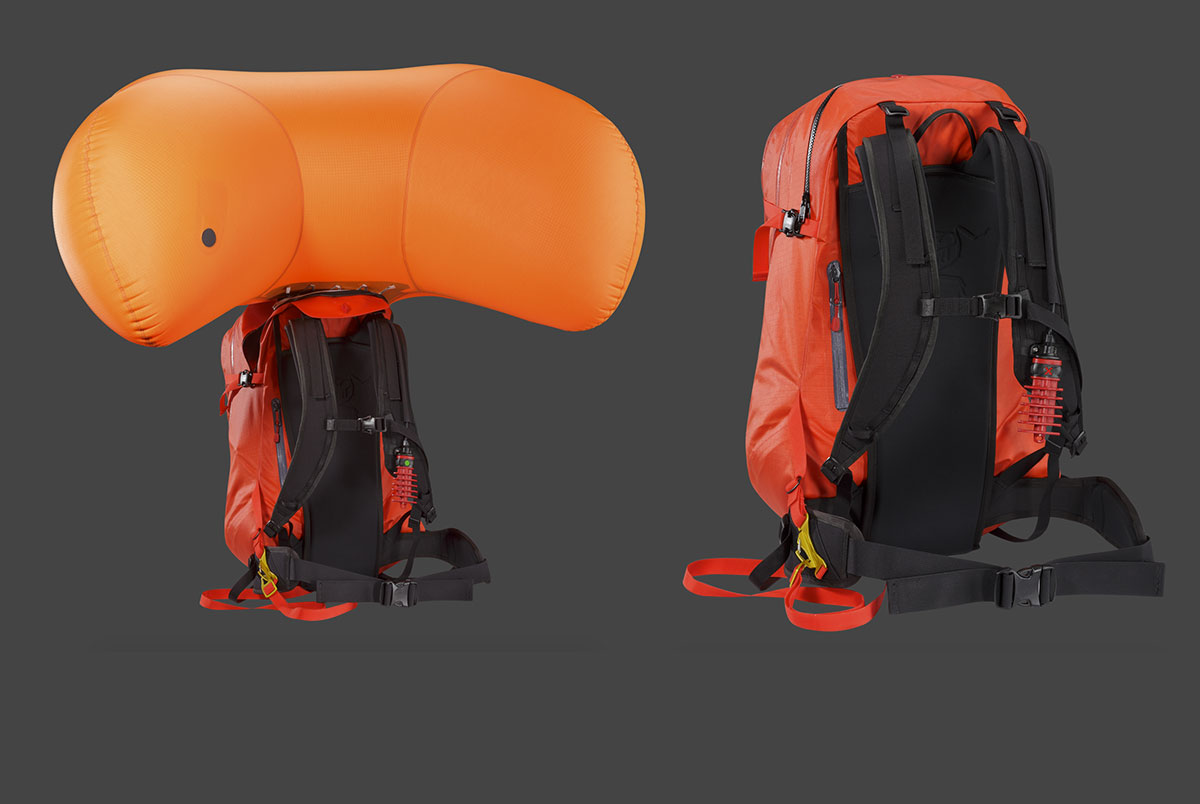
One of the things I find interesting about my job as that I have the opportunity to learn about all sorts of products that I might not ever see in my real life. One such product is the avalanche airbag. It never occurred to me that such a thing existed, but as soon as I read the words "avalanche" and "airbag" together, the concept made perfect sense. This is the item in question:

It is designed to keep the wearer "afloat" in the event of an avalanche. More information about the product is available here. Basically, it is a backpack that incorporates a sturdy balloon and an electrically powered fan to inflate it. Once inflated, the balloon prevents the wearer from being buried in snow.

In NY N274983, Customs was asked to classify this airbag enhanced backpack. My first thought was, "Oh no, this is going in Heading 4202 as a backpack." To me, that seems to undervalue the safety features. Moreover, none of the exemplars in 4202 have safety features. But, that is a straw man I need not fight, because 4202 was not in play. Rather, the importer suggested classification in Heading 9506.99.60 as sports equipment. Customs disagreed with that and noted that the airbag backpack is neither "requisite" not "essential" to any sporting activity.

Instead, Customs classified it in Heading 6307 as an other made up article of textile.

The thing about this device is that it apparently could be worn by anyone in an avalanche-prone area, whether or not participating in a sport. For example, I can see this being worn by the folks who groom and patrol ski runs, by park rangers, and by scientists doing field work. That makes me wonder whether the manufacturer might be able to modify the design to make it clearly dedicated to a sporting event. Customs did admit that it includes exterior straps designed to carry skis, snowboards, and ice axes. Is that enough to make it a product of 9506? Maybe. A more interesting question might be whether there is a clever design tweak that would make it clear that this is a "sporting" product? I don't know what that might be, but I hope the engineers at Arc'teryx are working on it.

Tariff engineering: It's value-added classification.

| | | Devamı » 26 Mayıs 2016 Perşembe Unknown 0 yorum